MODIFY THE NIKON TC-16A TELECONVERTER.
By Oliver Perialis
I bought a TC-16A, even though I knew that it doesn’t work on my D100 or the D200 I was planning to get. But I thought I’ll take it anyway, since I don’t have any usable converter and this one is pretty cheap compared to the other ones. I figured I’ll try to find out why it doesn’t work, since I couldn’t even find any useful information on that.
Research
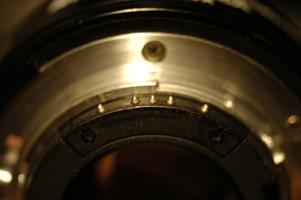 |
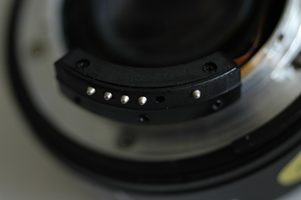
First thing I noticed is the different pin layout on the TC-16A compared to all my other AF-lenses. I’ll call these pins 1 X 3 4 5 X 7 (as seen on the picture of the TC, where the X’s stand for empty spaces). |
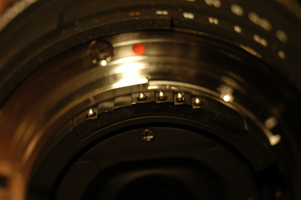 |
(above=TC-16A, here=Sigma 8mm) pins here: 1 X X 4 5 6 7 |
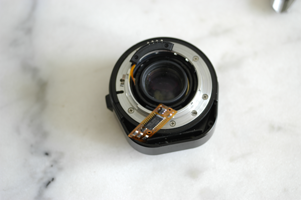 |
So I openened the Converter to have a look where these pins connect to. There is a CPU inside, just like in any AF-lens. |
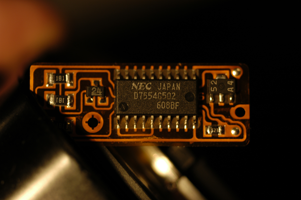 |
This is the front of the circuit print. It features a NEC D7554G502 “CPU” as its main component. Just for your information: the circuit print continues on the left all the way to the connectors: the top circuit path (top left pin of the IC) connects to pin 1 the next lower one (on left of the top resistor) to pin 3, then the next one down pin 4, then pin 5, and the very bottom circuit path (bottom right pin of the IC) connects to pin 7. |
 |
This is an IC I found which seems to be compatible. Turn it anticlockwise by 90 degrees to have it in the same orientation as on the picture above (front view). |
 |
On the back all the connections are visible.
|
| I didn’t want to open any of my AF lenses, to see where the difference was, but I didn’t need to after I found the results of someone having done exactly that (I could no longer find the source where I found this, so I cannot mention it here): [edit] Tazman (comment 75) found the source: A very interesting thread by “Ro Ro” on photo.net [/edit] |
 |
And what do you know!? – its basically identical! Except for one difference, which is exactly what I was hoping for…
Pin 3 (on the TC) which was out of place anyway is connected to the IC in the same way that Pin 6 (on the AF lens) is connected!
Research result: JUST MOVE PIN 3 to the (unused) position 6… that’s it!!!
Method
A quick note to begin with: Most the feedback I get about this page is that the people tried this modification and lost one of the small golden springs. So please be careful with those – I don’t know where to get any spares!!
 |
This by the way is what the circuit print looks like at the other end. |
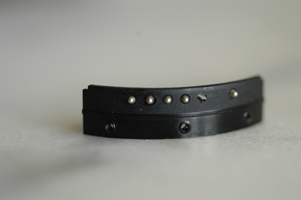 |
So I drilled a hole (1.4mm for those who want to know, or just slightly wider – the metal contact that needs to fit through is exactly 1.4mm wide) in position 6, and made sure the metal contact fits well, and moves easily. I drilled it by hand, NOT with a Dremel or so, but just by rolling the drillbit between my thumb and index finger. It took a little longer, but gave me a much cleaner result. |
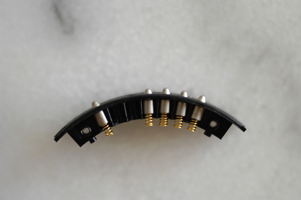 |
Luckily Nikon didn’t save every milligram of plastic they could and there is already a notch in which the metal contact can slide, without touching the other contacts. |
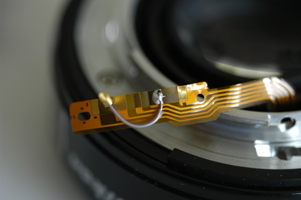 |
Now I soldered a little wire onto the little spring to electrically connect it to its old position on the circuit print. |
 |
Then put everything back together… |
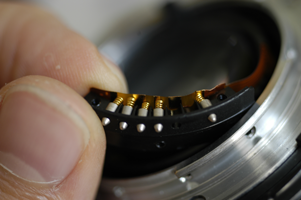 |
Oops, one more problem… The contact on the circuit print for Pin 5 is a little too wide and our new pin 6 would touch it as well, which is not good… |
 |
So I just covered that side of the contact with a little bit of cello-tape (I know this is not perfect, but the best Idea I could think of to make the whole process more or less reversible). |
 |
NOW put everything back together.. |
 |
|
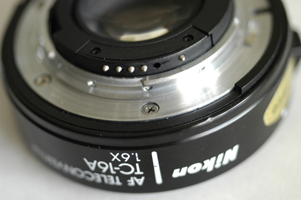 |
And finished!!! :-) |
D100 specifics
(probably more cameras, eg D70, D50, D80, F100, F80, etc)
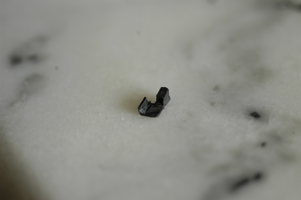 |
Just one more thing… |
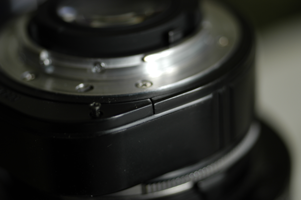 |
(I got an F E.E Error on my D100) |
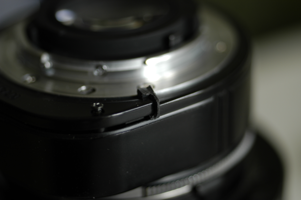 |
A little something (don’t know what it’s called) that moves a switch and this tells the D100 (and other cameras) that the aperture ring has been turned to minimum aperture (and so enables controlling all apertures via the camera). If you cut a piece of hard plastic (I used an old PC CPU fan) into the shape above, it fits really well (in a very good position) in between the Converter and the little cover for the “CPU compartment”. |
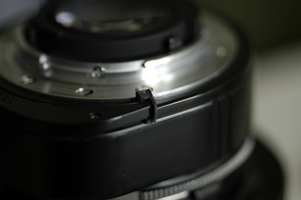 |
Now we’re really done!! – That’s it! |
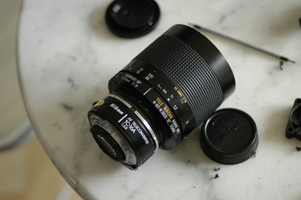 |
This is how it looks on my 500mm f/8 Reflex Lens One more note: the Aperture the TC transmits to the Camera is always f1.0, as minimum and maximum aperture. So it is not possible to change the aperture at all. My 500mm (which I mainly bought this converter for) has a fixed aperture, so it’s not quite so bad, but it would be nice if this were different. |
D200 specifics
(probably applies to D1 and D2 series, D300 and D3 as well as F4, F5 F6)
Since the D200 has AI coupling, there is no physical switch like for the D100. Therefore, the little plastic thingy will not be necessary. However, somehow it didn’t work anyway (same F E.E error). The Trick is: go to CSM (Custom Setting Menu) under f: “Controls”, position f5: “Command Dials”. There, under “Aperture Settings” choose “Aperture Ring”. This means you can’t control the Aperture via the subcommand dial anymore (so you’ll want to switch it back when you put a normal AF-D lens on the camera again).
Tools used
- Philips No.000 Screwdriver
- 1.4mm drillbit
- a very fine-tipped soldering iron
- a dremel (only for shaping the little plastic piece)
Parts used
- 1cm of very thin, insulated wire
- a small piece of hard (nonbrittle) plastic – got mine from an old PC CPU-fan
Limitations
OK, basically it works, but the use is very limited. It’s limited to the maximum aperture of the lens attached. On the D100 that’s it. Nothing you can do about it. On the D200 it only meters for maximum aperture, even if you set it to a different aperture. If you do want to use a different aperture, you’ll just have to dial in some exposure compensation.
Future Ideas
To overcome the aforementioned limitations, I believe the only solution would be to replace the chip with one that has a range of apertures, and not just “f1” for both minimum and maximum aptertures (this is what imposes the limitations).
Notes:
I will not be held responsible for any problems caused directly or indirectly by following the above instructions/information. Use at your own risk!
exact same springs are can be obtained from any dead pentax af lens.
Cool mod. If you need a replacement spring try the local jeweler. Out of curiosity I found that a spring from the pin that holds the strap for a wrist watch was the correct diameter. Could easily be cut to length.
Hello from Belgium ! I had wanted to make this change for a long time! It’s delicate, but it’s done, thank you for the tutorial. This TC 16a did not work with D3s, it is now OK with 300mm f / 2.8 Ai … however, the exifs are delusional: focal length 8mm f / 1 – lens 5.0 mm f / 1 …. and, it must make a voluntary under exposure of – 0.7 because it overexposes … Are there solutions ??? thank you ;)
@Frank:
The Electronic connection will probably work (when using the FTZ adapter), so you’d be able to control aperture from the camera and such (with the extended modification found in the comments). But it will not be able to Autofocus. The TC-16A uses the screwdriver type Autofocus, expecting the Autofocus motor in the camera Body, which the FTZ adapter does not have. the FTZ adapter only autofocuses with AF-S and AF-I lenses, which have the autofocus motor in the lens.
Will this work with the Z6 Camera?
My modified TC-16A work very well with my D300s and my MF lenses (50 mm. f1.2, 50 mm f 1.4; 85 mm f 1.8, 85 f 2.0, 105 mm micro f 2.8).
How I solve any problems?
I bought a brand new old stock Nikon TC-16 A on the bay, All incluse (original caps and original box and manual instructions) just professionally modified. I paid 205 $ by leonasj from Lithuania. He sell others…
All working fine, I just put the aperture ring on the lens on the smallest less one (if 32, I must put 22, etc)
And I’m happpy with my old AI’D, AI and AIS lenses, now autofocus
Hi all, i’m using a Nikon 500/4 P on a D7000 and it’s working great. Because the converter can’t cover the whole range of sharpness of the 500mm, it must be put manually allmost to focus position. The converter does then the trick. Kind regards, Renze
Anyone tried the Nikon 600/4 Ai-S with modified TC-16A?Will this combination work?
Haxxored today my TC-16A. Lost one spring, but I had a scrap guitar string which I peeled and turned into a spring using a needle as a mandrel. Nickel-plating conducts electricity well enough.
I finally got it working A-OK. Works marvellously both on Nikon D200 and D300s. Did test shots with Walimex 500/f8 mirror lens and Tamron Adaptall 70-250/f4.5 lens. ROCK! Just incredible gadget! Haven’t yet tried my Tamron Adaptall SP 60-300 /f5.4 lens, but the results have so far been encouraging enough!
Use of full-auto lenses is possible, albeit only on semi-auto mode (manual settings, raw adjustment close to the target and the rest with the TC-16A automatic). But this contraption immediately enhanced the use of mirror lenses especially on nature photography.
Has anyone tried the Nikon D810 with Ai-s 800mm f/5.6 ED IF Nikon with the Modified 1.6 TC? I’m wondering what your results were.
@lou
As nobody has given you a concrete answer to your question, I will give my guess. Your first question on the 1000 mm F11: In principle it could work, but I expect that any camera will have a hard time autofocusing at F11. Your second question on cameras: I have used the modified converter with success on the D300 and the D800 and I can see no reason why it will not work just as well with the D300s and the D810.
Hi Bob,
Right click on thumbnail pic and select “view image” then hold down Ctrl and tap + key to enlarge the image
A little tip that might help with the modification, will be to source a headphone wire cable.
Most have a old unwanted headphone/earphone stored.
The single wire strands are very supple and will manipulate into a tight space with ease.
It will make the reassembly less worrying.
My friend who modified my TC 16A, tried a few wires, and the headphone wire strand was his final choice.
The TC has been working flawlessly for nearly a year now, attached to a 500mm F4P,
300mm f2.8 ED AIS, 200mm F4 AIS, 135mm f2.8E, 85mm f1.4 AIS.
Wow, you have certainly exhibited a lot of patience to see this project through. As i read all of the comments, it seems that there have been a variety of attempts to achieve success. At this point, would it be correct to say that the modification entails two operations; moving and reconnecting one of the little plungers and, unsoldering pins 112 and 113 on the cpu chip. I’m good at following instructions, but don’t have sufficient knowledge to try a variety of experiments.
jim
Is there a reason that the photos are only available as tiny thumbnails? Unfortunately they’re so small that I can’t see any details. It would be great if they could be downloaded as high resolution images.
HI, has anyone used this modified TC-6A with a 1000mm f11 Reflex Nikkor?
Also, the D300S and D810?
Thanks in advance
Lou
Hi It.s Bud again,
Completed the IC pin disconnection and found the mod to be a great success. I can now make better use of my 50mm f1.4, 55mm f3.5 as well as my 135mm f2.8 lenses. Greatful thanks to you and all the other contributors.
Bud.
Hi Oliver, For those who are wishing to gain access to the IC to carry out Pin 11 & 12 disconnection. The use of Shellite to soften the adhesive of the double sided tape is recommended. As Shellite is a petroleum spirit keep away from source of combustion!! A few drops applied to the edge of the flex circuit will soften the adhesive allowing an easier removal from it’s mount plate. Shellite evaporates quickly and will not damage the plastic or effect other parts.
Bud
Hi, Oliver thank you so much for your insights into this TC16A conversion. Having carried this out I (at this stage without the IC pin disconnection) found that the AF operated on my D1, D7000 and D700 using f9 setting. Strange thing was when fitted back onto my old F801S the operation was still working fine which seemed rather odd to say the least. One would ask the question what was the reasoning behind Nikon’s pin variation in the first place why not utilise all of the pin connectors. Once again thank you for your support.
Bud
Hi all again so I purchased a modified Tc for my d700 and 2.8 300 mm .I am pleased to report im very satisfied with the results.very sharp.fast focus.The photo’s with this combo are better than with my d2xs with this lense and a unmodified tc.
Thanks again
Chuck
Hi,Great read.I have a 2dhs+ d2xs I uses with a 300 2.8 .TC-16A
It works very well on the d2hs very sharp fast focus.on the d2xs is does not focus as sharp.
I have a d700 now and only keep these other body’s because they work with the TC-16a.
If I change my TC will it cease to work on the D2’s?
IS THE D700 THAT much better than the D2hs or d2xs??
I have a wide lens I use in the 700 and Cary one of the D2’s with the long lens.
Would the modified TC work on a D7000? Im maybe replacing the 2 D2’s with D7000 to retain the DX Crop advantage??
Thanks
Chuck
Hi Heiner. I think your observed behaviour is quite consistent with Olivers description in the beginning of this thread. You must use the aperture ring to control the aperture. For me this works without problems.
Hi Russ. I don’t think this is possible. This very special TC was produced when Nikon was behind Canon and wanted to make it possible to use MF lenses on AF camers. Therefore it used the mechanical AF-connection at that time. Your camera is only supporting the much newer electronic connection. But fortunately there is still a lot of cameras out there supporting the mechanical connection, D70, D80, D90, D7x00, and all full frame cameras.
Is it possible to modify the TC 16A for my Nikon D5500? If not, is there another way to make AF and AI lenses to auto focus using my camera? Please help. Thanks.
Its me again (from post above). I observe an odd exposure behavior when using this TC: When I use the aperture ring on the lens, everything is fine. But when I switch to using the dial on the camera (via Custom Setting Menu: f: “Controls”, position f5: “Command Dials” -> “Aperture Settings”) I get heavy underexposure for SOME speed/aperture combinations (i.e. when I use aperture prioriy, I shoot photos with the same LV, but different speed / aperture settings. Does anybody see this also? Is this normal and I overread something on this forum?
PS: This happens with different lenses I tried.
Hi – I just wanted to say THANK YOU – to Oliver and the other active contributors!
I bought a TC-16A via ebay; it arrived yesterday and the conversion went smooth (contact exchange and P112 and P113 lift-off). I am using it on my D610 – now I can use my late fathers Macro Lenses (105/4 and 200/4). It uses the entire aperture range (4 to 32 on both lenses) and the whole thing is amazing. 2 AF Macro-Lenses for 85 bucks. Me so happy. :-)
@Scott
This simply will not work at all. The TC calculates the correct AF by moving the glass elements, it basically it’s a lens itself. If you remove the glass elements of say a 50mm/1.8D, would you expect it AF? Simply no.
Also, by removing the glass, the TC becomes an extension tube… losing all functionality. Why would you want to do that? The flange distance will simply not allow an “autofocus” adapter to be made without being a teleconverter or an extension tube of some sort.
It’s not possible, physics won’t allow it.
Hi there,
I have one of these working great on my 500mm f4p to make it 800mm etc.
I would love to have the autofocus functionality WITHOUT the teleconverter functionality.
Taking the aluminium sleeve with both of the glass elements out of the teleconverter appears to stop autofocus working because the sleeve is attached to the autofocus motor.
1) If only the front glass piece on the teleconverter were removed and the back piece were kept do you think that would help? If so anyone know how to get it off?
2) If both pieces of glass on the teleconverter were removed but the sleeve that they are in was still connected to the autofocus hook do you think that would help?
Anyone figured this out?
Hello
Thank you all for your long term dedication to a subject that creates healthy curiosity.
I have been following this Modified TC 16A Toic since I invested in a Nikon 300mm f2.8 ED IF.
I was blown away by its potential and wanted to get the most of it, so I was rewarded by discovering the clear instructions offered here.
I now have a Modified TC 16A, and it is offering a much improved experience of the 300mm f2.8,
200mm f4, 85mm f1.4.
I would like to inform the readers of my experiences to date, as I have not read any comments that relate to my concerns.
The 300mm f2.8 had a Dandelion chip attached by myself and worked perfectly on my D800E, the sole purpose was to have command dial aperture control and focus trap, both worked perfectly when programmed to the camera body. When this was attached to the TC 16A it worked with out any need to go into the Menu f controls f9 and set up the Aperture settings. The concern I want to inform you of is that after about 10 times of attaching the 300mm lens to the TC 16A the Dandelion chip was damaged and the outer wall was destroyed exposing the inner pins. Prior to the the use of the TC 16A
the 300mm lens with Dandelion chip had been mounted on the camera body approximately 50 times.
My conclusion is that if a Dandelion chip is to fitted on a lens with a intention to use a TC 16A as well, the Chip would benefit from being mounted a little bit deeper than flush with the top surface of the black metal rim that is usually shown in the installation information.
Nobody wants the broken of Chip parts in their Camera Body or Lens !!
Back to the TC 16A,
When setting up the TC 16A with the 3 lens mentioned above, I kept getting the fEE flashing and could not get rid of it, using the f control, f9 Aperture Setting. I believed the modification had to be a good one as the 300mm + Dandelion chip lens had already interfaced with it correctly.
In the search for a solution and attempting to discover my mistake, I witnessed a individual rotating a small tab that projects from the top of the front face of the lens.
The effect of this rotataion is that it scrolls the Aperture settings on the LCD screen, I copied this and my LCD screen did the same scrolling through the apertures and the setting of the fEE.
I set this rotating tab monitoring the LCD to the f stop one stop wider than the smallest f stop of the chosen lens and then mounted the lens with the Aperture ring set to one stop wider than the smallest f stop.
I now have three lenses that all interface with the TC 16A and the camera body will change aperture using the sub command dial.The projecting tab is accessable with a lens in place and if the mounting of the lens moves the rotating tab, it can be repositioned with a small probe to rotate it, once set
it is robust and does not require any further attention.
As I have said I wanted to inform you of my concerns and I hope solutions.
My TC 16A may have a fault in the Tabs rotating mechanism, I do not know, what I do know is that with a very small amount of additional input I have 3 EXTREMELY sharp lenses that can now function in a RETRO version of AF operation. I have joined this club, keep on with the posts.
With the 300mm + TC 16A I am now capturing hedgerow birds handheld and 25% of the images are keepers, about the same as I get with the 70 – 200 f4 hand held.
– Continuing from yesterday, was able to peel off the double sided tape from the CPU end of the circuit, although I did worsen a portion of the circuit coating which was already weak. Then I found a couple of broken contacts on the circuit, one of which required me to create a 4mm bridge with a copper strand to connect the leftmost leg of component 52 to its appropriate trace! It then struck me that I could mount the TC without its front cover to help with troubleshooting. The TC was dead at first, but after some trial and error I found I could get it to wake up by pressing down on the top left corner of the CPU with my finger. Given that the CPU is a few mm away from the front cover when assembled, with the help of a small ball of foam inserted in the gap, I was able to get back in business! Imagine that!
So after having tinkered with an AI’d 200 f4 Nikkor-Q on the TC for a bit, I had a few questions:
– On a D3300, the camera instructs me to lock the lens at the smallest aperture, but when I do so, it does not seem to register it and does not allow any photos to be taken. Is that normal?
– On a D7100, I am able to take photos in M & A modes, but I get an FEE error in other modes. Is that normal? Is there a way to take photos in S mode?
– EXIF data for the photos indicate a 70-210 F4 AF lens set at 145mm. Is there a way to customize that on the D7100 to show a 200mm F4 lens?
– When using faster lenses such as an F2.8, the aperture on the camera shows F4 wide open. Is there a way to tweak that to show the correct aperture?
– It seems like the AF is a little bit off. What’s the proper way to use AF fine tune to check / fix that?
Thank you in advance!
– OK, finally some good news. Sorta. Can’t remember what drove me to start tinkering again, but I discovered I could make my own springs by winding a copper strand around a pin (from a safety pin). I felt these handmade springs were superior in conductivity to the springs I had been using from the spring bars for watch bands, which appeared to be stainless steel. However, the TC was still dead.
– Before giving up, I looked at the CPU end of the circuit one last time to see if I could find any broken connections. I couldn’t visually spot any, so I gently pressed down on the circuit and its components with my fingers hoping it would fix any loose connections. Then I mounted the TC on my D7100 with zero expectations that it would work.
– To my surprise, I saw the full autofocus icon on the top LCD for the first time! Boy did my heart leap when I half pressed the shutter and heard the TC come to life. So exciting! I threw on a couple of manual lenses and it took me a while to figure out that they only worked wide open.
– I then proceeded with the P112+P113 pin mod, and in a moment of misplaced confidence, decided to use double sided foam tape to permanently fasten the slightly beat up CPU end of the circuit to its post, thinking I would never have to see it again. The pin mod worked great, and I was able to control aperture on my 200 f/4 using both the aperture ring and the camera body! I took a bunch of sample photos while grinning in disbelief at how well it was working.
– And then, as suddenly as it had come to life, the TC decided to stop communicating with the D7100. Such a bummer. My guess is I have a broken connection somewhere on the CPU end of the circuit, and using the foam tape to fasten it probably worsened the problem rather than eliminate it. So now I have the unenviable task of freeing the friable CPU end of the circuit from the foam tape, and assuming I don’t botch that, go over every trace and connection to identify loose or broken contacts and fix them. But having had the taste of success, albeit fleeting, makes me look forward to this daunting task :)
– Sincere thanks to Oliver for this invention and everyone on here for your contributions that helped me get here! Such a rush!
– Redid the entire mod using a copper strand per post #215. I also reassembled the contact box a few times to make sure nothing was shorting accidentally. But no dice. Camera won’t recognize the lens, nor would it Autofocus.
– Checked the circuit on the CPU side, and found a small defect that I had created, and remedied it. Still no dice.
– Although I didn’t get the mod to work, I’m glad I didn’t give up after my first attempt. Definitely learned a lot about how CPU lenses work, troubleshooting electronics, and soldering technique. I cannot emphasize enough the importance of picking the right size wire for the mod. It helps if its light and pliable. As for soldering technique, making sure your wire tips and the solder tip are tinned ensure that your solder connections are made quickly without exposing the circuit to excess heat.
– Now to go unleash my newfound learnings on other unsuspecting lenses ;)
– Making headway. Using a copper strand (instead of a section of stranded wire) worked brilliantly to make a viable connect to the trace for contact #3 (after scraping off the coating on the trace, of course). The strand was super light compared to the solder joint, but strong enough to hold the weight of the spring, and pliable and easy to position. Also, its small size allowed me to reassemble the crowded contact box effortlessly.
– However, I was unable to get the lens to autofocus on the D7100. Not sure if I had a short inside the contact box due to the springs not being positioned properly, or if the springs from the watch spring bars are just not conductive enough, or if I’ve damaged the flexible printed circuit with all the tooling around. I’m hoping its the former and that I can get it working in a couple of tries.
– Any advice on troubleshooting why it isn’t working will be greatly appreciated.
– Gave it another go yesterday and was able to do a decent solder job. However, when I tried to close the contact box, a couple of springs jumped out. On the second attempt, the solder joint between the wire and contact #3 (more accurately, the trace for contact #3) came apart. I feel the weight of the small wire and the spring is too much for the solder joint. Also, the wire needs to be super tiny so it fits in the crowded contact box.
– Once thing that helped with the contact box reassembly was using simple glue to stick the flexible PCB against the backing piece before reassembly.
– I have ordered a conductive ink pen to see if I can trace out a conductive line instead of using wire to make the connection from Pin #6 to Trace #3. Until it arrives, I may try to make the connection with fine copper wire and tape it down to the flexible printed circuit with insulation tape. Will report back on how it goes.
– Almost there. Got a dozen or so 10mm long, 1.5mm wide spring bars from a watch store for no charge. The springs inside are comparable in size to the original springs in the TC.
– I was able to solder a spring to the wire tip, and the other end of the wire to what remained of contact #3 (Oliver, thanks for the tip about scratching off the solder mask. I was able to do that with an exacto knife, although it is a delicate job like you say). However, when I tried to assemble the contact box together, it took me numerous tries and the soldering finally came apart.
– I feel part of the problem is I’m having trouble getting solder to stick to the iron or to the parts. I’m going to give it another go tonight with a fresh batch of solder, and maybe using extra flux just in case.
– Anyone have trouble getting the contact box closed up? My pins and springs kept falling out of place. Any tips in that regard would be appreciated.
– Lastly, I have a very tiny washer (about 3mm OD) that I believe fell out when I opened the front of the TC, but I have no idea where it goes. Any pointers there would be greatly appreciated.
– Feel like I’m on the home stretch. Just a proper solder job and a contact box reassembly away from Nirvana :)
– So I received the 35-70 f3.3-4.5 AF that I was hoping to scavenge for parts. Sadly, the contact box is a different design compared to the TC-16A and is glued together as a single piece and is slimmer. Since the 35-70 arrived in usable condition aside from some fungus, I was reluctant to break it open just for the springs, as they might be a different size anyway.
– I did manage to free the CPU portion of the flexible printed circuit on the TC-16A. I did it the hard way by taking apart the front of the TC, which was a royal pain to put back together as it has a number of small tricky parts. Turns out it could have been done without taking apart the front IMO, albeit with little less room to work with. Not sure if others have been using a heat gun to loosen the glue.
– As for disconnecting pins 112 and 113, is it OK to use fine tipped pliers instead? I feel my solder gun tip is way too thick to desolder these tiny, closely spaced pins.
– At this point my gameplan is to buy an assorted set of spring bars for watches and identify the size that has springs that are closest in size to the TC contact springs and use those for the mod. I will report back on how it goes.
Oliver, thanks for your detailed response! I was inspired by your tenacity and gave things another go.
– I bought a new tip for my iron as well as a desoldering braid (they didn’t have a wick) from Radio Shack.
– As for springs, I went to a watch repair store and they gave me a few spring bars for free. I was able to break them and use the springs inside as backup.
– However, I was unable to successfully solder the wire tip to the spring. Part of the issue was getting solder to stick to the new solder tip. I went through most of my remaining springs and finally gave up.
– I also tried to work on disconnecting pins 112 and 113 from the CPU, but was unable to get the CPU part out as it was stuck with glue at the bottom. So that will have to wait for later.
-I have ordered a busted 35-70 f3.3-4.5 AF so I can use its springs and perhaps the other CPU parts if needed. Once it arrives, I’m going to give this another shot and report back.
Thanks for your ideas and encouragement. I can’t wait to get it working so I can report back here triumphantly! :)
@gustafson: sorry to hear about your problems!
– getting rid of excess solder is best done with solder wick.
– I have no idea where to get those springs, if not from another (broken) lens. You’ll have to find an old one though, newer ones tend not to have springs. But before giving up entirely because of the spring, you can try using a spring from a ball-point pen, and twisting it tighter. I haven’t tried that, but it might be your best shot.
– the flex assemblies probably differ between those lenses and the TC, only the CPU will be the same (and it won’t make a difference which of those lenses you chose, you can choose the lens type by soldering/unsoldering pins 112 or 113 – see comments 8 and following)
– if contact 3 is beyond repair, you can always try to run a new, thin wire from its contact point near the CPU next to the flex pcb, and solder it onto the resistor near the CPU, or if you have a fine-tipped soldering iron, you could even scratch the solder mask of the traces on the PCB, and solder a thin wire directly onto the trace… but that’s not for the faint of heart ;-) Hopefully there’s enough left of contact 3 to solder a thin wire to.
– There should be nothing to worry about with the D7100. It should behave like the D200 rather than the D100 (it can handle the aperture ring). I’d go for the extra modification in comments 8 and following, to make the TC pretend to be a 70-210, since that would most closely match your lens.
Oliver: Thank you for discovering and sharing this mod, and thanks to all the contributors!
Unfortunately I failed at my first attempt at this mod for the following reasons:
– Used a soldering iron that wasn’t fine enough for the job.
– Ripped out a chunk of contact 3 on the flex cable while trying to twist off excess solder.
– Got too much solder on the spring 6 that prevented it from compressing.
– Worse, spring 7 caught on the excess solder on spring 6 and launched off to god-knows-where.
This is rather delicate work and excess solder is a real bother.
Needed everyone’s advice on how to salvage this situation. I plan to ultimately use the modded TC-16A with a 200 F4 Nikkor-Q on a D7100. Can you weigh in on the potential options going forward:
– Get a replacement spring (where from?) and try to continue and reattempt the mod with a finer soldering iron and hope that it works?
– Get a broken 35-70 or 70-210 and transfer the CPU assembly (contact box, flex cable, CPU) over to the TC-16A. (If so, am I right that the 70-210 would be a better choice as its aperture matches that of the 200 f4?)
– Any other options that I should consider that I’m missing?
Thanks in advance for your help!
Hello Oliver,
Please ignore if you’ve been asked this question.
I have a D90, 300/f2.8 ED mf, TC-16a.
All I’d like is the AF feature, pin relocation I’m assuming…
IF I don’t do the chip mod, can I still shoot manually, have AF, and just get
the display errors, which I can live with, or is the chip mod necessary?
Finally, can I pay you to mod the TC-16a for me, pin mod and/or both, as my knarled fingers are a hinderance to say the least?
Thank you for a wonderful site!
John
Amazing. Working on D7000 with Nikkor 80-200 2.8 and very old manual Nikkor 105 F4 Micro.
With P112 and P113.
Thanks a lot.
hi oliver,
i did the mod and match it with 400mm f3.5 of mine…they work great on my d7100…i relly hope that will compile all the modification instruction into one complete guide..and youtube vid will be great also…cheers!
@aakash: You either need to also do the second part of the modification (as described in the comments 8 and following) and then choose a setting that matches the aperture RANGE of your lens (5-7 stops), or change your settings of the camera so that you can control the aperture from the aperture ring (as described in “D200 specifics” at the end of the instructions.
Hi,
I did finally modify the TC-16A after going through your instructions, thank for that. I have a problem though, i can get the auto focus to work but i get an FEE on my D300, i need help solving this issue, thanks
[…] haben allerdings Methoden gefunden, den TC-16A für weitere DSLRs nutzbar zu machen, siehe dazu hier. Dass Nikon niemals reine AF-Telekonverter gebaut hat, sondern nur AF-S, hat einen gutem Grund: […]
Unfortunately, tc-16a and my 500mm P do not work good with eachother, I am getting frontfocus which cant be fixed with AF finetune.Plus that I find the quality of the image to degrade quite much, compared to my tc-14b when used with the 500mm P.My tc-16a is just modified in terms of switching the position of the pins, nothing touched on the cpu.Any sudgestions, or it is what it is?
Hi Xhevi, I can’t give you any info on the chip replacement for the Tamron, but maybe someone else knows something.
While the 35-70 and the TC-16a use the same chip, I doubt that they use the same contacts and pcb layout, and therefore can’t say if you’ll manage to cram it into the space in the TC-16a. But do take some photos, no matter if it works or not – might be interesting for others too. Just replacing the Chip makes no sense, as it is the same chip, so you’ll still have to carry out all the mods…
You don’t need to match the Maximum aperture. You need to match the Aperture RANGE of the lens you want to use – The camera bodies need you to set the lens to MINIMUM aperture in order to be able to set the Aperture from the command dials. All metering is done at Maximum aperture (no matter what value it has), and then the camera checks what you set the aperture to be, calculates the difference, stops down by X EV, and also corrects the Exposure metered by X EV, then takes the photo. So the camera doesn’t use the absolute aperture, but just a relative aperture from the maximum aperture of the lens. So choosing the right maximum aperture is only important for the EXIF data.
hello all.
I did modify my TC-16 5 yeas ago, and it worked fine. but I also must say that I haven’t not used it since. maybe once or twice.
maybe not related to this mod, but I purchased a tamron 300 2.8, af that needs the chip replaced to work on the newer bodies. so I have been looking at that mod for a while and refreshing my memory with the info on this site. any ideas?
anyway. back to this mod. I found another TC 16a and also got a broken 35-70 to just replace the cpu and contact instead of fiddling with the soldering. anyone used this replacement?
another question; why should we match the lens max aperture when with this TC we loose 1 1/3 stop?
a 2.8 will turn into a 4.5 theoretically that should lead to underexposed photos.
however last week I used the TC-16 with a Nikon 180 2.8 cant say they were underexposed.
I don’t know how the new TC with cpu in them deal with this.
A friend of mine fixed the damage on the tc-16a and got it working.I tested it with my manualfocus lenses today – the 50mm f1,4 AI, 100mm f2,8 E series and the very old 80-200 f4,5.The last one was the best imo, although all showed some frontfocus, which got better but a little bit stayed even at AF finetune on +20.I will try it with the 500mm P tomorrow and see how its working for birds in flight.
I am unsure how much it does, but the focal length can influence how the camera tries to focus. It could be that Nikon only categorises focal lengths (super wide, wide, normal, tele), but it could also be that it distinguishes more finely, and therefore getting as close to your used focal length as you can, could be desirable. Apart from a little extra work, there is no reason not to do it. :-)
Hello Oliver, thank you, i succesfully did the full mod thanks to your suggestion! If someone needs a picture of the cut leg of the pin let me know and i will make it, but your picture is very clear. The 3rd step is to mod the chip to have 210mm, but is there a benefit other than pure exif? thank you again for your wonderful web page
@dilom: Oh-oh. You have a problem. Your options are: a) scratch the soldermask off the trace (the very very thin line of which there are 5 in parallel). it’s made of copper and you can solder a wire directly onto there. It will require some serious soldering skill to get it right. b) run a wire along the same path all the way down to the CPU, and solder it on there (onto the resistor).
@juliaan: Here you go: P113 and P112 are the 2nd and 3rd pin of the top row (right above the “NEC” text on the chip) I usually don’t cut them, but rather de-solder them and bend them up, but it’s much easier to cut them (fairly close the the chip)
Hello can someone publish one or two pictures of the real chip with the already cut pin112 and 113 ? Because i’m not sure what are the pins to cut. With a real picture it will be safer to do it, otherwise there is the risk to cut the wrong pins. One or more pictures are useful i think. Please help. Thank you
Hi all,
Oliver, thanks for the amazing thread!I bought an unmodified tc-16a and tried to modify it, but got stuck.While trying to put it back together, had it tough due using a little bigger wire.Then the soldering on the circuit print fell together with the copper place on position 3.Now all I have is this (picture below).Any sudgestions how to make it work?
Plus, I cant find the cpu.
Thanks in advance for any comments!
http://i575.photobucket.com/albums/ss200/dilomski/20150208_092210.jpg
What an amazing thread. A career 30-year-pro…but had never heard of such a thing. Oliver, whoever you are, you’re famous now. I believe all of the “modified” TC-16s on ebay are a result of your Out of the Box thinking. I have no desire or the skill to DIY – that’s what You guys apparently do in your sleep. I’m going to Buy It Now for around $200, already modified. If my 500 f4 P becomes an autofocus lens I will be thoroughly speechless. Thanks everyone!
Hi mr Oliver,
I put circuit zoom nikon 35/80 into TC 16A because is flexible.Exif 50mm f3.5.It is very fast and I don’t have the external box whit vetronite circuit of tamron 28/200.Thank you very much for genial idea to modify TC 16a
[…] 2.Конвертер не поддерживает электронику современных камер. Конвертер работает с камерами до Nikon D2H и старше по возрасту. Для современных камер требуется простейшая перепайка, с которой справится любой. И конвертер начинает работать на Nikon D700, D300 и моложе по возрасту камерах. Здесь можно посмотреть подробную схему перепайки конв… […]
Hi all, first of all thank you very much for the work you have done and shared. Recently acquired TC 16A and I will use a Tamron SP 300mm 2.8 lens on a Nikon D300s, which recommend making me apart from the modification of position of pin 6 ?. Would need to explain to me if I do something else with connections cpu. Thank you very much, greetings to all from Argentina !.
I have just acquired a modified TC-16a. It works fine on my D1x. It does not work at all on my D7100. No AF at all. Any ideas where I should look to start debugging the problem?
Thx Oliver for your information. I modified my TC-16A with change pin 3 to pin 6 location, and cut 112/113 on the chip. It works well on my D700 as well as D200. Especially, my old 55mm micro-nikkor lens becomes an auto lens with right exposure after using the modified TC-16A..
Agian, thanks.
Dear mr.Oliver Eureka!I installed the circuit tamron 28/200 in a plastic box of 5x5x1 cm.pasted on a hot shoe.Thanks giorgio
Dear Olivier,
Many, many thanks, my 300 2.8 IF ED (first series, i’m too poor to afford anything else) became again sharper than ever!!! As expected, EXIF 145mm, and all the rest works perfect.
I would recommend for the connection just to bond a custom cut of very thin copper, because to pass an isolated wire from pos 3 to 6 is a challenge, especially to close back the pin holder in its slot. For the 112-113 story, to unsold is also a challenge, I would recommend to avoid losing time to simply cut the two legs.
Anyway, super trick I recommend to any TC16 owner, it took me in total 2 1/2 hours. Once tested, you will never want to come back to original.
Bertrand
Dear mr.Perialis I remove pin 112and 113 and the PCB is death! I connect the circuit of Tamron zoom 28/200 3,5/5,6.Exif:focal lengt is 155mm and max.aperture is 5,6.TC 16a works very well except MTO 500f8.Little problem is to install the circuit!Thanks giorgio botta
Thanks for your great DIY instruction and helped lot of people like mw on tight budget.
I have D90 and 300mm f2.8 manual focus lens (1986 model) i would like to but this converter and diy my self is it focus faster and do i need to manually focus close to subject and then camera focus sharply right
Thanks in advance
Oliver,
I think that is precisely what happened. I guess I have the 16A locked to where the F32 stop would be if the 500P did stop down to F32. Since I only use it with this lens, I have no qualms about locking it in this position. At 50 meters focus distance this tc/lens combo yields an 800mm F7 with about 6 to 8 meters of focus range; good enough for many wildlife situations.
THANK YOU for publishing this info and keeping the this page up.
Regards,
Dewey
@D.Clark: I believe what you found is the same as setting the aperture ring of the 500P to F/32, is it not? This is (and has been) the main advantage of using the secondary modification (that’s only described in the comments so far) – disconnecting pins 112 and 113.
If you want to control the Aperture of any non-G lens from the camera rather than the aperture ring, you must always have the ring set to minimum aperture, such as F/32. If you don’t , the lens is mechanically limited, and the exposure can be off, if the camera is trying to use a smaller aperture than the one the aperture ring would be set to. This is why the camera won’t allow this, and will display the FEE Error until you set the Aperture ring to min. Aperture.
When you add the TC-16A, this minimum Aperture setting is still needed, but it doesn’t always correspond to the minimum aperture setting of the lens. On some lenses it’s one stop below minimum aperture (such as F/22 if the min. Aperture is F/32) or on some it might be one stop or so more.
The important thing is that you must find that setting, and leave the aperture ring at that setting at all times, or you’ll get the FEE error. With the secondary modification (Pins 112 and 113), and finding the right position for the aperture ring, you’ll get full matrix metering and PASM options, and the ability to control the aperture from the command dials.
Oliver
Thanks to everyone for this work. I have a contribution. I am using the modded 16A on my 500P F4 and a D600. I moved the contacts and cut pins 112 and 113. I discovered that if you move the aperture sensing ring on the lens side (as opposed to camera side) of the TC counter clockwise (away from the aperture sensing stop block on the 500P), there is a point at which the FEE error disappears when the camera is set to control the aperture form the command dial. On the TC body, this corresponds to the “TEL” of the Telconverter printed on the body. I used a small piece of plastic between the TC body and the sensing ring to hold the lever at this position (so it never springs back).
This yields FULL control from the camera and no need to set the camera to control the aperture from the aperture dial. Full PSAM and dead on metering. Exif still reports 210mm F4; but if this bothers you you can change the custom lens data to 800mm F7.
I know this is long after the main interest, but others may rediscover the manual lenses and want to add some AF to them now that we have an “affordable” full sensor body.
@ David H, firstly, sorry for not periodically checking back at this site, I have been busy shooting pix all 2013 (did a 365 project), in response to your question, I am using an AI version which has AF, it is the f/4.5 ~ 5.6 Push Pull AF version (non-D). My primary goal with this conversion was to use it with a 500 f/4 P which it works without problem. Sounds like you lost a pin. for you and the group: You can buy old lenses through KEH.COM rated Ugly and scavenge them for parts, it is less expensive, then you have lenses and parts you can take apart to play with if you are a DIYer.
Those using the D7000 do not forget you have to go into the menu and change the Aperture control from [sub command dial] to [Aperture ring]for the TC to operate, failing to do so will not let the TC work.
again: Special thanks to Oliver and everyone else who have contributed to his web page.
here are some helpful links for lens info
Asian website in english very good site on older lenses and accessories
http://mir.com.my/rb/photography/companies/nikon/nikkoresources/teleconverter/tc16a/index.htm
An older website with great info on exotic nikkor lenses
http://www.naturfotograf.com/lens_surv.html
Ken Rockwells website (great reviews/info on lenses and camera bodies)
http://www.kenrockwell.com/nikon/nikkor.htm
and if you are interested in contacting me or see what I am up to you can browse my blog
http://digipaintersblog.wordpress.com/
Thanks everyone who contributed here, hope this site stays alive as there will always be someone tinkering!
Tim S
Tim S –
Which version 70-210mm F/4 lens are you using? My reason for asking is that I have an E-Series Nikon version, and have read where the TC-16A will damage the lens if I try to mount it. Camera body is a D7000.
Hi Guys – Well, I finally had a go at this conversion, and (boy am I mad at myself) lost one of the contact pins!
If anyone has a TC-16A for parts, or a spare pin or two and would be willing to trade or sell them, PLEASE contact me. Thanks!
Dave Honey
I just purchased a TC 16a on eBay in ‘excellent’ original condition after reading much about how to get limited AF functionality from the TC 16a. – Thanks to all contributors.
I have a beautiful Nikon 600mm f4 ED IF Ais lens serial # 2010xx – later design, but manual focus and my failing eyesight has made it almost impossible for me to use.
I have D2h, D300, and D800 bodies that I would like to use the lens with, and I would like ‘advice’ on how to proceed – I am very comfortable with fine pitch soldering and de-soldering, as well as dealing with ‘small parts’ , i.e. springs.
I also have a ‘for parts’ disassembled Nikon 70-210 f4 – 5.6 lens with CPU for parts.
Appreciate any and all detailed advice on the use of the three bodies with the TC 16a, I understand the TC 16a and D2H will work together ‘as received’ (assuming the TC 16a is as original per eBay listing) so I will give it a try to get the knack of the TC 16a and verify it can focus with the 600mm F4 IED IF AiS lens.
But for D300 and D800 bodies I needto make a decision for modification(s) as I understand – the bodoes will work with modifications of pin 3 and lifting legs of CPU –
Can the CPU and pin connector from 7-0-210 help, or will it be more of a problem since there will be no grey code inputs?
Is there a CPU for a 600mm f4?
Thank you in advance for any and all replies.
This mod works on my D800 and Super Cosina 100-500 f/5.6 – 8. Meta data reports correct aperture, but the aperture is manual now. Not really a problem for me. Set up 210mm per post #49.
Special bonus: The lens with mounted TC still fits inside the lens case. Hah!
My modified TC-16A (with pin-swap and P112-113 cut) is working fine with D800E and 500mm/F4P
This guy had success with a D800.
http://www.flickr.com/photos/episa/8524385526/
I am thinking of getting this for my D800/500mm f/4 P IF-ED combination, but see that some people have reported difficulties on the D800.
Is that confirmed, that the modified TC-16A does not work with the D800?
Wow what an interesting read, about the possible modifications to the (humble) TC-16A. Rather above my ‘not-so nimble fingers’. My wanted use for the TC-16A, was to continue using the combination of it, with a Nikkor 300 f/2.8 manual lens. It works well enough on my F 4 camera body, but wanted to use it on my D70, or Fuji S5Pro. I would not want to tinker with the converter, and lose the film body functions, but was hoping that ‘Nikon’ had brought out a digital body version.
Thanks for allowing me to read about your expertise in the modifications carried out.
Regards Paul.
@TsaiProject: That’s a great idea with the copper tape!
Hello Oliver. Many, many thanks to you and the contributions of Soren Klostergaard and Jaco Mostert. Today I moved the pin. Instead of soldering a wire, I used the copper tape idea to bridge contact 3 to six. I have not yet unsoldered P11_2 and P11_3 but will try this later. this is the result:
http://www.flickr.com/photos/tsaiproject/8929829523/lightbox/
Nikon D700 + 500mm AI-S P + TC-16a. CHEERS! TsaiProject
This has been an amazing and entertaining read, thank you for doing this.
Question: Will this work on this combo?
Nikon D800
Nikon 400mm f3.5 Ai-S lens
If so, what is involved? Thanks.
@ Oliver, again Thank you for your article, I was successful and now my D7000 can use the TC-16a (pins 112-113 lifted from contacts for correct readout in meta data when using the 500mm P lens & 70-210m f/4 zoom) Might I suggest you you condense all the pertinent data concerning the mod to one page, this would save one from having to scan through the comments for relative info. One item that might also be mentioned is the additional wiring might cause one to have to notch the back of the pin plate so it will fit when sandwiched back together. . . anyway several hours and the fruits of my labor where a success. hope everyone that tries this meets with success, but be careful, it is not something a neophyte will want to do. All things fun have their challenges.
A picture using the Nikon D7000, TC-16a and Nikkor M/F 70-210 f/4 can be found here.
https://plus.google.com/photos/101346514804541774366/albums/5828618339283434609/5835605721676121314
Tim
@oliver p. That would be awesome! I’m going to attempt it over Xmas but would love to have the video to fall back on. Thanks
@Nippa: coming soon, some time early next year! I won’t have time for that before CES in January.
hi Oliver, how about a YouTube vid to help us less hands on types with all the fiddly bits
First off , Thank you Oliver for taking the time and effort to not only experiment with the TC-16a but share with us everything, and secondly to keep this post alive since 2009. I have had the wonderful Nikkor 500mm f/4 P since 2006 (my fave Birding lens)and have often thought how nice it’d be to have that smidgen of focus ability as my eyes are growing older and I have now moved into bifocals :( . . with that said you can imagine my feeling surprised and a bit happy at finding your post regarding the Mods to the TC-16a. I ordered one this morning and have read the entire blog, although not seeing anyone using a D7000 I am sure it will probably work as it is much like the D700 and D300 so the mods should work well. I will use the plastic part from a donor lens with the appropriate holes for the pins and lift the two pins. When done I will do some test and report back on your site. Thank you for sharing, and also all those whom have contributed . .
Tim S.
…and in case anyone is wondering, YES! on a D90 it does focus on a bright star at 500mm f/8 (now 800mm f/12.8).
Simon
Dear Oliver
I’ve just joined the army of enthusiasts who have taken on the modification of the TC-16A thanks to your very helpful work here, (plus a few extra bits from Jaco and André Mostert). Thank you for all the effort you and others have put in to sharing advice and experience on these pages. I am now the proud owner of an autofocus 500mm (now 800mm) Reflex-Nikkor on my D90. As my interest is astrophotography, the autofocus will be used almost exclusively to find infinity, as the 500mm reflex has no hard stop!
Best wishes
Simon
Hi. I’d just like to say thanks for all the information here, and to suggest a different approach to moving the connecting pin on the teleconverter. Instead of soldering direct to one of the tiny springs, I added a new contact to the ribbon PCB. The procedure, with picture, is outlined in this thread on Photo.net.
http://photo.net/nikon-camera-forum/00aytU
If done carefully it means that the converter can be easily put back to its original pin configuration and there’s no risk of damaging a spring.
If you want to reproduce the picture of the mod here I can email a copy of it to you.
Regards “Joe”
Hi Oliver, I would like to thank you for your time publishing the above and sharing your knowledge..i have done my modification on last 2 years..i very happy with the combination TC16A with lens Nikkor 300mm f2.8 Ais & Nikkor 500mm f4P.. for result pls feel free to visit here http://www.flickr.com/photos/50265798@N07/
Can you suggest the correct pin disconnections/earthings for a Nikon 400 F3.5 AIS ?
It has 6 stops from F3.5 to F22
Any other tips? Its going on a D800 and I would like to continue to use the command dial on the camera to set aperture. Can I leave the ring set to F22 as I do now?
Thanks
Graham
Hi all,I try th e modified TC16A with my Nikon D300 and 300mmf4 MFand 400mmf2.8MF and work very well! I am satisfied.Quick focusing on 400 and 300mm lens .Perfect exposure.New life for my MF lens.
I tried my modified TC 16A on a D800 and to my surprise it did not work, i.e. It did not focus correctly unlike my D200.
Hi! Thanks for the TC-16 mod!
I have not read ALL the comments, so I don’t know if someone else already have suggested this; but it strikes me that a smart thing to do would be to dispose of the CPU in the TC-16 altogether! And make “female” contacts on the “lens-end” of the TC-16, an d just pass those trough! Thus you would always get the right focal-length & aperture- reading on the camera and in EXIF. You may have to dial in +1EV to correct for the 1EV loss, but I think the meter would take care of that anyhow…
Soren.
Thank you for the informative reply. You made a very valid point by saying that tack sharp superceeds any optical difference in the other teleconverters. I have a Jobu Black Widow gimbal with an alum Induro 413 tripod rated at 44lbs. It seems very rigid but I am a neophyte with regard to the Nikon 500mm f4 P and its abilities. I also am anxious to implement the req’d long lens technique.
I was informed recently by one who modifies the TC-16A, that there could be a conflict with the D800 but he was unsure. There were very few D800s in use at that time for anyone to offer any input.
Thanks again for your response! John
@John
I don’t have a D800. But the 500 P with a modified TC-16A works very well on a D700 and I can’t see any reason why it wouldn’t work on the D800.
Until I found this blog, I have used the TC-17EII on the 500 P. I have not made any systematic tests, but to me the ability to get the focus tack on gives much more IQ to the image than any optical differences between the TC-16 and the TC-17.
However, I find that the TC-16E on the 500P gives a substantial vignetting on full frame.
I find that the 500 P and TC-16A is able to give stunning images that leaves nothing to be desired compared to my 300mm 2.8 VR with the TC-17E – provided it is supported by something like a Gitzo series 3 and a gimbal head and provided proper long lens techniques are used and provided the atmospheric and light conditions etc. are OK.
But this is a subjective judgement on how it works for me!
hi, I modify the tc but with the 180 ed ais the diafram are blocked and there is a F1 message, and in p mode on the camera(d700 d300) fe error, you can explain me the modify on the tc body, for correct manual f number control? grazie thanks leo
@Frank: Yes.
I have a Nikon D1x. Will these mods allow my D1x to work with (some) non AF lenss in AF mode? I understand the prefocus and focus range limitations. I have a lovely Sigma 300F2.8 I have been dying to use this way. Thanks
The modification looks wonderful. I plan to get one for use on Nikon 500mm f4 P and D800. I have 2 questions: Has anyone used a modified TC-16A with a D800 and was it also workable? Also, is the TC-16A optically comparable (sharpness and contrast) to the E and EII series teleconverters? Thank you for your response and research on this modification. John
Grazie mille! ho applicato la modifica ed ora la mia D3 ed il tc16a funzionano perfettamente… Many Thank’s, Leo
The Modified TC-16A works Wonderfully with the 400mm F2.8 ED AIS.
I modifried my own and the lens (640mm ~F4.5)is super sharp with D300.
It does show a bit more contrast stopped down one more stop.
Hello,
@Leonas Yes, You need a modified TC-16a.
Hello,sir.I have nikon D700 and nikkor MF 85mm f1.4. Is possible AF with TC-16A,or i need modified this tc like on this website?thank you
@Kirill It’s not possible. The AF in the TC-16a is “screwdriver driven” and requires the Camera body to have an AF Motor, which the D3100 does not, only cameras from the D7000 line (D90, D80…) and up have that.
Hello,
How make Af on my nikon d3100. It is possible ?
Hi all,
I did the pin switch and used the copper tape method to redirect signal from new pin 6 to the old pin 3. Not only did I not get any AF action but the lens reports as a manual lens on my d300, no chip detected.
Before ‘mod’ I did briefly mount this TC on a Nikon N2002 to test whether it worked, it did not. Subsequent research suggested an unmodified tc 16a would not be compatible with this camera. Did I brick the electronics? Since I never tested it with an older camera before modifying I’ll never know!
Any suggestions besides putting the pin back, finding a ‘control camera’ & testing it in ‘original’ condition would be appreciated..
Thanks,
DDK
I have fully modified the TC16-a. The little IC pins were set for the 210mm F4 selection.
The unit works and now manual lenses also can use the thumb & finger controls for the aperture instead of the Aperture ring if desired. Great results with 200mm F2 AIs and 400mm F2.8 AIs.
I even tried the 400 with a TC301 and then the TC16-a for a very long 1280mm F9. It auto focuses how ever the contrast and sharpness are a little lacking but it AUTO FOCUSES!
The 400mm F2.8 with the TC16-a is a great bird lens!
Thank you SO MUCH! It works well for the D200, D300 and D700.
If you do the mods yourself Please follow the instructions about using a tupperware to keep the teeny tiny springs from flying all over. Also be very patient during reassembly. YOU will get it back together. Keep trying (took me about 45 minutes and ~7-8 tries)
Thank you very much Oliver…! (please..be patiente with my bad english.. :)
I have a Nikon D90. I made the pin changes like you teach us, and have an excellent result, all right with the auto focus.. great.!! I didn´t cut P11-2 and P11-3 and for that the max F1 is there. Could I use the ring of lens without guess change the CPU of Tc-16A. I read all your specification about changes on the camera controls on the D200 and later. I use all MF Nikon 105mm F2.8, 135mm F2.8 and 180mm F2.8 and I want to use the lens ring for change the aperture diafragma. With the TC-16A mod I have the fine last autofocus but the manual ring for control the aperture don’t result, the aperture is fix on the max, the same case with the three different Nikon lens F2.8.
What can I do for use the TC-16A autofocus and at the same time have control aperture with use of the lens ring..?
Thank you again, for this excellent and generous publication.
Kinds regards
Roberto
Hello, great site, thank you for sharing your knowledge! Has anybody already tried to REMOVE THE GLASS from the TC-16A to use it as AF-macro-tube for MF-lenses? Or is this impossible? Perhaps the diameter would be to small, or removing the glass would cause damages … (?)
Thank you very much for your advise! Let me try again when the sun is out!
Cheers!
@Alan, if you read through the comments, you’ll see further modification described, which would explain the f/4 display.
It sounds like you’re trying to focus on something outside of the focussing range, so it will hunt back and forth once and give up. (as any other lens would too). Also, forget using it in the dark, especially combined with the 500mm f/8 Autofocus will only work in bright sunlight.
You need to pre-focus your lens manually, and then (half)-press the shutter, for the TC to be able to auto-focus. It’s range is quite limited.
Hello!
I am incapable in doing the mod by myself. I therefore bought a modified one from a reputable guy off ebay who claims using the same mod solution from u/your site.
It works with my Nikon 50 1.4 and 105 2.5. But it doesn’t work with my Tamron 500mm reflex(same as yours)! The lens only move back and forth once (as if there is no lens attached to it) when I half pressed the shutter button. I already changed the camera setting to Aperture Ring. The aperture display shows f4.0 instead of f1 in your description.
Assuming the mod is done properly. Did I missed anything/tricks?
Your help is much appreciated.
Thank you.
Alan
“Hello, wouldn’t it be easier to just remove the pins and to glue a dandelion chip on the converter?”
Laurent,
I was thinking that too, but it does not work. Dandellion chip has a programmable virtual AF/MF switch, but it is only for focus confirmation. Camera does not autofocus with Dandellion chip.
I disconnected P110 & P103 from the circuit.
I expected focal length=85mm, aperture=1.2(variable)
but the result is focal length=8mm, aperture=1(fixed)!
What is my mistake?
Thanks Oliver for discovering and sharing the TC-16A can be converted.
I just want to use the TC-16A with MF 85mm F1.4
So I move pin3 to min6, then Auto Focus is OK
BUT (as you expected) maximum aperture problem is remained.
I read many time this article
but I don’t understand
[84. Sover Wong Says]
PINS MAXIMUM APERTURE
113-110 Present Ideal ==>(what is the meaning of ‘Present’ and ‘Ideal’)
1101 1 1.4 ==>(what is the meaning of ‘1’ and ‘0’)
1111 1 1 (initial state)
PINS FOCAL LENGTH
103-100 Present Ideal ==>(what is the meaning of ‘Present’ and ‘Ideal’)
0000 70 8 (initial state)
1000 210 85 ==>(what is the meaning of ‘1’ and ‘0’)
I really want to use the TC-16A with MF 85mm F1.4
but I don’t know the next step after movement of Pin3 to Pin6.
Please let me know some detailed infomation .
PS: Sorry for my poor english ^^
Hello, wouldn’t it be easier to just remove the pins and to glue a dandelion chip on the converter? The chip can be programmed at will afterwards! Did somebody do that ? As the focus is set by the camera and not the converter, it should work, isn’t it ?
Laurent
Thank you all guys very much for having this thread….
I sold off my old 170-500mm(my only birding lens) as I came across a manual 300mm f2.8. At the same time, I know of a photography shop near my place who still has 1 tc16a with them, though unmodified. I have always wanted a 300mm f2.8 with a 1.4TC but just couldn’t get enough $$ to buy them…ok, I bought both, even got a friend to recommend a friend who knows how to modify the tc. I thought it was done, yeah, I thought I was having my dream lens combo…
then for past week…I have been testing and testing and seeing this front focus issue…I have been adjusting my mirror angle on my d90 for whole week but couldn’t get an adjustment to accommodate this combo with my 17-50mm f2.8, 10-20mm,80-200mm f2.8. I was so frustrated…nothing is more frustrating than having a great lens but having inaccurate AF.
Finally, I saw this thread…read through thoroughly and “took the plunge” to cut P112, P113..Boom! I am having accurate AF! and now I don’t even need to switch my flash mode to M to burst as it reads the lens as TTL and the front dial is working too. I really thank you geniuses who have started, and contributed to this thread!
yes, the TC becomes a “non-cpu lens”
you’ll have to first use a screwdriver to “focus” the TC-16A to a spot, so that you can use the entire focussing range of the lenses you want to attach. You’ll have to find that spot yourself though…
What happens if you remove all the pins and springs? Does it then simply become a 1.6x manual teleconverter that allows you to focus lenses manually?
Hi, I just got a TC16A and decided to modify it myself but already have a question. After removing the two screws that fasten the pin module to the lens I could not remove it and did not want to force it. Do I need to remove any other screws such as the screws in the lens mount? I don’t want to damage anything by forcing but I don’t know just how this module is supposed to come out. Is it pressed into it’s position and requires some effort to remove? Thanks for any advise.
Peter D
Thanks to the detailed information given by Oliver and to the help of Erik Lund, I now have a modified TC-16A that works great on my D200.
Just an FYI the D7000 live view function works with the modified TC-16A and my 500 P. What an amazing conversion you have discovered Oliver.. Kudos!
@Roy
As stated on the mir.com.my website that Klaudiusz linked to (a very good resource on all things Nikon, by the way), the TC-16a was meant for the F-501/N2020, and other early Nikon AF bodies, such as the F801/N8008, F4, F90.
I found no info on the F-401/N4004, (or their iterations, s and x).
I just read in the F601/N6006 Manual, that “The following teleconverter/lenses cannot be used with the N6006. (Correct exposure may not be obtained using these accesories). – AF Teleconverter TC-16/TC-16A
I just tried the F90x, and it autofocusses and meters, although it only shows F– on the LCD (I don’t know if that was normal with the other SLRs too).
From what I have read, it is also compatible with the F5, F6, but not the F100!!
I don’t know about the F50-F80 Series.
The only compatible DSLRs are the D2 Series: D2H, D2X, D2Hs and D2Xs, not even the D1 Series nor the D3 Series and none of the other DSLRs (D40-D90, D100-D300, D70, Dx000,… ) are compatible without modification.
I cannot guarantee the correctness of this Info.
@Roy, All required information about TC-16A you can find there: http://www.mir.com.my/rb/photography/companies/nikon/nikkoresources/teleconverter/tc16a/index.htm
Can you supply a list of bodies that the tc16a will work with without any modifications. I have D2Xs,,D100..F4e. Also will it work in manual on F2s ?,,,,,,,,,,,Thanks,,,great in fo,,,,,,,RM
@Craig
I don’t know what the exact problems might be, but Nikons warns about using the TC on a modern body. The pin has a new function – if you look at VR lenses, you’ll see that all the pins are used (plus a few more), so the TC might be putting input onto an output pin, which can cause damage in the long run. Of course Nikon probably added quite a bit of protection circuitry to prevent anything from happening…
@KC: Your aperture range does not match the lens you set the TC to be. if the actual range of the lens you put on the TC is less than the one the camera expects, you’ll never be able to reach the expected minimum aperture. if your actual aperture range is bigger than the expected one you’ll have to set it to one stop below minimum aperture, for being able to use the sub-command dial to control the aperture (and not get the fEE error). Of course, you can also set the camera to use the aperture ring for controlling the aperture, and you’ll never get the fEE error.
If you’re using a Camera without AI-coupling (such as the D40, D50, D60, D70, D80, D90, etc) then you’ll need that little piece of plastic described in the modification under D100 Specifics, to get rid of the fEE error.
@Soren if you also perform the second modification described in the comments -removing pins P112 or P113, so that the TC “pretends to be another lens”, you are no longer limited to using the Aperture ring, but can control the aperture with the sub-command dial. You have to carefully choose the setting, to match with your lens (especially aperture range), for that to work – you’ll have to be able to “lock” the lens in the minimum aperture position.
@Keith Ng: The pins on the CPU (P112 and P112 – number 18&19 in the drawing of the circuit) determine which lens the TC “pretends to be” since you want to use longer lenses with the TC, it is probably adviseable to use the setting for the 70-210 lens…
although you must check if the aperture range will fit as well, or you’ll get the fEE error, if your lens cannot reach the expected minimum aperture position…
I’m planning to do a more detailed writeup on this, since having to read through all the comments is a little much…But I don’t know when I’ll find the time.
@Oliver :: I’m still wondering what possible harm an unmodified TC-16a could cause to a DSLR of any of the recent models. Do you have any idea or experience as to what this could be?
Considering that on my D200 and D700 (I’ll test the D70 just for fun) the metering showed 1-6, it seems like the camera was getting enough data to control exposure, it seems like the unmodified converter is at least adequate for the pure telephoto capability with longer lenses. Any thoughts?
Thanks!
OK update on the previous post is that after changing the aperture from Sub-Command dial to Aperture ring control, the Fee error is gone in M mode. However, the aperture is showing as F 1, and the focal length is 8mm. But all that said the really good news is that the lens is focusing well by itself, though I have to guide it closer to the focusing range.
So thanks to Oliver and all of u, I managed to convert a $40 teleconvertor to work with my D300s. Btw, do I still need to do the chip or will shud I just use it in manual mode and enjoy the nice macro photography……. All replies will be welcome
Cheers
KC
Hi guys,
Thank u for the lovely write up. I managed to buy a tc-16a locally and did the two mods i.e. pin change and side adaptor for the Fee error. Now when I mount the teleconvertor on the D300s, it shows the focal length and autofocuses (i.e. the glass element moves front and back) But the moment I mount the lens (80-200 f2.8 push pull type old lens from the 90’s) it starts giving the Fee error again. CAn someone point to what is going wrong…. Would appreciate feedback.
Regards
kc
[…] […]
Regarding Nikkor 600mm F4. I own a Nikon 600mm F4 AI manual focus lens. I need to move the infinity focus out slightly to accommodate a modified Nikon TC-16A autofocus converter. The problem that I am having is that with the converter, I cannot achieve focus beyond some distant point. Just a little more might do. However, I am not sure which screws to unscrew on the lens to adjust it. I have done this on other lenses, but this one has me baffled. Anyone out there with experience with this lens and the infinity adjustment????
I’m not able to use the Live View function on the D300 and the D700 with the modified TC-16A
According to Nikon, aperture ring control of lens aperture will disable Live View Mode on D300 and D700 when a CPU Lens with a mechanical aperture ring is attached. Nikon suggest using the sub command dial. (http://support.nikonusa.com/app/answers/detail/a_id/16465/~/d300-%2F-d700-live-view-mode-disabled). I suppose that the modified TC-16A is exactly working like a CPU lens with mechanical aperture ring.
As Oliver points out in the beginning of this thread the TC-16A on the D200 the aperture must be controlled by the aperture ring and not by the sub command dial. The same is true for the D300 and the D700.
This probably means that it is impossible to use the Live View function with the TC-16A. Anyway I have not been able to get it working until now. Any thoughts or any experience?
Thank you very much
Soren
Dear Oliver after I read so many comment I basic know connet pin 3 to pin 6. But cpu part still misunderstander. Can you give some advice. I using D1x : I want to use my 50-300mm f/4.5 & 180-600mm f/8
Thank You
Keith
The Live View function on D300 and D700 is not possible with the modified TC-16A.
For some strange reason it is not possible to use Live View together with Aperture Ring control on CPU lenses with these cameras. If you want to use LV on CPU lenses, you have to control the aperture from the camera. But this is not possible with the modified TC-16A. Hence the Live View function is impossible.
Please correct me if I’m wrong. Although I’m not using the LV very often, it can be useful.
@ Oliver: Thanks so much. I’ve tested the unmod TC16a on the D200 & D700, and I can’t imagine what possible harm it could do to the camera. Have you any idea what that might be? Nikon has always been quite conservative in their language about compatibility of various combinations.
On your suggestion, I’m considering removing the pins to make it a strictly manual glass. I’ll report back with my optical results when I get anal about testing it thoroughly.
Thanks again!!
Craig
@craig:
NO, you cannot assume that. In fact, Nikon warns, that you should not attach the (unmodified) TC-16A to incompatible DSLRs, because it might harm the camera. Only the professional DSLRs up to the D2Xs supported the unmodified TC-16A. Not even the D3 Series support it anymore, and no other Series ever supported it.
So only use it at your own risk.
the common 6-stop range makes it easier which of the possible pin-combinations you’ll want to choose.
NO, the 80-200’s AF won’t work, it will be “replaced” by the TC-16A’s autofocus, which is quite limited. You will need to manually “pre-focus” the lens, and the TC-16A will do the fine-tuning AF.
the 18-200 might not work so well. I haven’t tried it, but generally, wide-angle lenses don’t work well with TC’s.
So, you’ll have to decide whether the modification is worth it.
It’s a pretty good TC, considering its price, so even if you don’t use its AF capabilities, that alone would be worth it, if you have one already (since you shouldn’t really use it on the D200/D700 without the modification!).
But then again, if you don’t need AF, you might as well just “modify it” by removing the entire circuit with the CPU and the contacts, and rely on the camera to meter correctly using the aperture ring.
Oliver
Ok, I found a detailed explanition regarding pre focus of lenses for TC-16A at http://www.mir.com.my/rb/photography/companies/nikon/nikkoresources/teleconverter/tc16a/index.htm .
Great stuff here!
I have sucessfully converted my TC-16A. This is really tricky.
With my Rubinar 5,6/500mm mirror lens it works like with other long lenses – as semi-AF. This means you have to prefocus manually, and then the TC-16A does the fine-tuning. This is really helpful with this lens, because it is really hard to focus manually. The focus is very sensitive to small movments of the focus ring.
The TC-16A easily does the fine tuning with spot on focus, either with phase detector, or with live view.
Does anyone know a reason why the TC-16A cannot achieve full focus on long lenses?
Is the moving range of the AF element to small?
The other question is whether someone already achieved AF with the Dandelion chip. I have added already a dandelion chip to the Rubinar T2/Nikon adapter. This works pretty well. But it would be also nice if I could use a Dandelion on the TC-16A, in order to get correct EXIF data.
So has someone achieved AF with the Dandelion chip added to the TC-16A?
Thanks!
First, what an impressive array of creative and helpful folks (with steady soldering hands)! So please bear with me as I try to summarize “what we’ve learned so far” and what I need: Comments and clarifications most appreciated!
Can I assume the following are true:
The TC-16a CAN be used on any current DSLR and lens without harm and without modification.
It WILL “work” as a manual teleconverter in any combination (on lenses with manual f/stops).
It WON’T “work” as an autofocus adapter for manual focus lenses without the modifications detailed here.
Manual focus and exposure (auto or manual) WILL be accurate in most configurations.
I’ve got a D200 and D700. I’m looking at working with an 80-200 f/2.8 AF and a 300mm f/4.5 (old) lens. Both have 6-stop range, and both lenses on both cameras show the f/range going from 0 to 6 as the lens is stopped down.
Given the issues some have noted with front/back focus errors, trickiness of the modiications::
is it really worth the trouble of trying to create an autofocus lens out of the 300?
Would the already AF 80-200 autofocus work properly once attached to the modified TC16a?
Would my 18-200 D (no manual aperture control) lens work properly on a modified TC16a on the D200?
Thanks folks!
Thanks for the input.
I could not make it work so gave it to my son Mike to look at. He has a D300s. Had the same result but found that if he manually set the A1 aperature pin to f11 it worked just as it was supposed to giving correct readings and taking great photos. He is sending it back to me with a pin installed to set the ring as it is installed.
Any idea why this is required. All other camera settings are normal default.
@Ken
Just a supplement about the FF error:
If you set the “Command dial” “Aperture setting” to “Sub command dail” you get the FF error with the TC-16A.
The “Aperture setting” must be “Aperture ring”. (The menu text is from the D300 – as far as I remember the D200 has semilar settings)
@Ken
I use the fine 500 P with my D300 and the TC-16A. I have cut the p112 and p113 and get correct aperture reading (in A or M mode).
The AF range IS very narrow on this long lens – the AF is only for fine tuning. It takes some practice to use the focus ring correct. I have found the TC-16A very useful getting birds in focus – even birds in flight.
OK, think I have it now. The location as showen in photo link of #79 is correct.
I have removed both p112 and p113 but still get a fEE.
Any sugestions.
Again my camera is a D200 with 500mm F4-P MF lens.
It will attemp to focus but in a very narrow range. If I focus on an object behind my subject focus occurs. If I focus on an object in front of the subject a focus motion happens but focus is not achieved.
I have been studying your photo of the CPU. It looks like I need to desolder the top second from left and the top 3rd from left. 18 and 19 on the CPU. I am confused because the photo link in comment 79 shows a different location. a location I would call P101.
Help.
I have a TC-16A that I am modifying to use on my D200 with a nikkor 500mm f4-P
I have the contact bridge modified and reassembled.
I am not sure which pins on the CPU to lift. I know they are 12 and 13 but how do I locate them.
Something info for you. I lost one spring but took a contact spring from an old Times Ironman watch. It’s diameter is a few thousanths large so I unwound the gold wire and rewound it using a straight pin as a mandrel. It came out nearly perfect. works freely within the bridge.
comment number 100 – wow!
maybe it’s time to make a new page with the information from the comments…
the TC-16 (without A) is only for the F3AF
I don’t know of any possible modifications – I don’t have one, nor do I have a F3AF to do any tests with.
Hi,
I know that exist also a TC 16 (not “A”) teleconverter that has a built in motor.
Do you know if is possible to do the same modification?
Thanks
Han: The dandelion chip is set to AF as default, so if you changed it status, it now says the TC 16a is a manual focus lens.
I have chipped all my manual focus lenses with the dandelion chip. I plan to use contacts from an old body and connect pin by pin from the lens to the body. In that way I can get correct exif info for the actual lens.
I just found this page. How does the D300 / TC 16a function with the older MF lenses without modification? What are you gaining with the modification?
Excellent. Thanks for posting this instruction. I just did it as per your instructions – took me a while to work out which were pins 112 and 113 to cut though. and I used a solder pen – very easy compared to solder iron and it seems to work perfectly so far. I have a nikon d300 and using a 400mm f3.5 lens. Very nice. Thanks again.
Anyone has tried dandelion chip with TC-16A and managed to get the AF up n running ?
Hi,
The modification of my TC-16 A for my D700 and my old nikkor lens Ai-s 200mm f/2 ed if works very well.
Autofocus works well.
Exposure metering also after cutting the pin P11.2 on the chip and after putting the F9 at “aperture ring” in the Custom Setting Menu of the D700.
Thank you very, very much Olivier.
BTW, i know that the original TC-16A works with D2X, but I would like to have the aperture dial function instead of using the ring.
At the same time, the TC-16A misfocuses on the D2X. Hence if the Dandelion can do AF with TC-16A, everything else would be great!.
Please update if anyone can get it working.
cheers
I have tried taking the chip out of a TC-16A and installing the Dandelion in. I then setup the min/max aperture + focal length and used the ‘5.6 AF/MF’ function to change the chip to an ‘AF’ one.
The TC-16A, however, does not become AF. The in-body motor of my camera does not turn the TC-16A motor.
Using it on a D2X.
hi, i am not sure if i understand how to modify the tc-16a. ist it just enough moving the pin´s, or do i have to change the original prozessor from the tc-16a unit? i don´t understand if i just can use the original prozessor unit.
when i modify pin 3 to pin 6 do i have to use the old pin 3 contact and connect this with a cable to the new pin 6? is this right?
thanks greetings maetsches
There was just not enough space for 5&6 to be contact it together !
Could it be if I had blocked the contact #5 by using the cello tape to isolate the new contact #6 on the conversion?
Having studied the Dandelion, and tested my modified TC-16A with different lenses, I’ve concluded it’s not worth the effort and expense because the TC-16A meters correctly using the lens aperture dial. The aperture indications on my S5 are wrong, so I just ignore them and use the aperture ring values instead. BTW a f2.8 lens becomes a f4.8 lens due to the 1.6 magnification.
My modified TC-16A does not have front focus problems, with all the lenses I’ve tried, including a Nikkor 50/1.2 and a Tokina 300/2.8. Could it be that Nikon used a different CPU in some TC-16s? The serial number of my TC-16A is 263403
Bi the way the focus worked fine before the conversion on my D2H and F5 bodies.
Hi Oliver.
Thank you very much for all your time and effort I really appreciate it.
2 weeks ago I successfully accomplished the conversion and made it work with my D300 and D700 bodies.
The problem is front focusing , on both bodies and with all the lenses I try it with.
The main lens I want to use it is Nikkor 400 F3,5 Ai .
I read all discussions , but some of it is heavy for my english and electronics knowledge!
Can you help me with simple advise how to fix it, if possible.
I took it to Nikon SA but the technician there failed to tune it, he says it’s impossible to be done, which I doubt!
They are just too busy for these small things.
The Focus I always get is in front of the image I am focusing.
The fins focus tune inside the D300 doesn’t help.
Regards -Peter
I just saw the Dandelion chip web pages. Very interesting. I too would like to know if anyone has tried it.
Removing the CPU printed circuit and contact block in the TC-16A could be tricky.
Thanks Oliver for discovering and sharing how the TC-16A can be converted.
I’ve just modified my TC-16A, bought for £20 at Photographica London last Sunday. The only deviations from your instructions are that I made two groves on the back of the pin holder for the wire to pass through, and I used a 1.5mm drill to match the size of the other holes. (Actually I used an 1.2mm drill first, and when it was off centre slightly, I used it to elongate the hole before finishing it off with a 1.5mm drill.)
My modified TC-16A works perfectly with my Fuji S5, without any front or back focusing problems. As expected, some pre-focusing is needed with fixed lenses. However, with the Nikon 50-300mm f4.5 ED, there is FULL AF range from near to infinity at 50mm to 85mm, and progessively limited to longer distances from 105mm upwards. AF was lightningly fast too. I am really happy with my ‘new’ 80-480mm AF lens.
It’s a pity that Nikon did not have the foresight (actually will) to make the TC-16A to work with a much wider range of lenses. It would be great to have the following :
PINS MAXIMUM APERTURE
113-110 Present Ideal
0000 4 13
0001 4 11
0010 4 9.5
0011 4 8
0100 3.8 6.7
0101 3.8 5.6
0110 3.8 4.8
0111 3.8 4
1000 1.8 3.3
1001 1.8 2.8
1010 1.8 2.4
1011 1.8 2
1100 1 1.7
1101 1 1.4
1110 1 1.2
1111 1 1
PINS FOCAL LENGTH
103-100 Present Ideal
0000 70 8
0001 75 16
0010 85 20
0011 81 24
0100 117 28
0101 109 35
0110 94 50
0111 101 55
1000 210 85
1001 195 105
1010 169 135
1011 181 200
1100 126 210
1101 135 300
1110 155 400
1111 145 500
This way, an 8 way Dual In Line (DIL) switch at the base of the TC can be set to match almost any lens.
I think programming the 4-bit processor would be an easy job for someone with the knowhow. Pity it’s not me.
Did anyone try to replace the chip with a Dandelion chip? See: http://filmprocess.ru/nikon_spec_en.htm
Yea I just changed the command dial to aperture ring. Only then works on my D700. D300 works anyway. Thanks everybody for contributing to this. God bless
Hey there.I almost did it.
It works on My D300 but not on the D700.
Any ideas why?
I’ve got a TC-19a today. Planned to modify it. I tried attaching it to my Nikon 500mm f8 mirror. And now, I can’t detach it from the lens. Could anybody help?
bruno manunza:
take a look at the following image which indicates where pin P11-2 is located. cutting/ lifting this locks the cpu @ 50mm/f1.8. hope this helps you.
http://picasaweb.google.co.uk/lh/photo/ZCajErwjq0-nKMs4s-Z2YA?feat=directlink
Just modified the TC16a (only moved pin 3 to 6. It works fine. Now I’m planning to disconnect P112 and P113 but i’m not really sure which they are. Can someone please mark the m inthe photo of the front circuit print?
Thanks
Bruno
following the excellent instructions provided here and in the Mostert PDF, i successfully converted my tc-16a last week and without the need for any wires or soldering. instead i used copper tape (the conducting adhesive type) to create a new contact pad for the relocated pin and connect it with the old one across the top of the contact box.
i locked my cpu @ 50m/f1.8 by lifting P11-2, which was a royal pain to do. when i do the next one, i’ll just cut the pin on the cpu as rejoining it later if required would be far simpler.
if you are planning to use a range of lenses with the tc-16a, i don’t see the point of locking the cpu at anything other than f/1.8 as i’m not sure the camera AF system takes any notice of the cpu-reported focal length.
with the cpu @ 50/1.8, the AF works nicely with all my lenses (regardless of focal length) so long as i set the lens manually to infinity-focus and accept a shorter minimum focussing distance, which on my 50/1.8 ais nikkor works out at a very acceptable 4ft.
i found that setting the lens focus to less than infinity allows closer AF but that then it only works some of the time and when it fails, the green LED indicates a focus-lock despite the subject under the focus-sensor being clearly not in focus.
to obtain accurate metering with slower (than f/1.8) lenses i apply appropriate compensation which all just works out in S mode. if using A mode i need to set the desired aperture minus the compensation. so, if using an f/2.5 lens in A mode, i apply +1.3 stops compensation and set aperture f/1.8 when i mean f/2.5, and so on … if that makes sense.
@Tazman, thanks for the Link – the thread has become even more interesting than the last time I saw it, it was revived in 2008, and some valuable info was added!
I finally added the source to the diagram.
Maybe I’ll get to work on a new (programmable) chip for the TC-16a at some point, where everyone can select the lens they want to use… when I have some time.
Hi Oliver,
Thanks for this sweet mod. Funny thing with my attempt (using D90 and N70) was that disconnecting P11_3 and P11_2 (to set the chip as a 70-210/f4 and kill the autofocus errors of the default configuration)resulted in an aperture range of f/3.8-25. Also, for some reason, on my chip, grounding P11_3 (to set the chip as a 50/1.8) didn’t work and still shows f/1 on the D90.
Anyway, sticking with my f/3.8-25 configuration and autofocus is sharp when used with a 50/1.8D.
By the way, I ran across the source for your CPU pinout diagram: http://photo.net/nikon-camera-forum/00956N
Hello,
I have done the modification and after a few tests I have put it back the way it was.
I used the modified version of TC-16A on a D700 and with a 50mm f1.2.
First of all, the modification is by no means an easy task. Do only attempt with the right equipment and only if you feel confident with it.
In my case, even though I was being super careful I managed to loose one of the springs. Luckily I found one to replace it in an old printer.
After the mod the lens does not communicate the aperture to the camera. This generates an error which can be solved by changing a setting in the D700 to allow the camera shot and control the aperture using aperture ring. This lets you shot but the aperture is still not read by the camera so forget about the light metering. It’s back to hand held light meter in your hand or guessing the exposure. Far from ideal.
Now, the pseudo autofocus; yep, it worked, kind of. When it finished the mod and tried for the first time I was quite impressed it worked at all! It’s very cool to see a manual lens auto focusing but…. it was way out!. I get the idea of pseudo autofocus, approximate manually and then use it, but still. It was obviously out when compared to my focusing by eye manually. I was testing this on f1.2 so a tiny bit out is enough to ruin any image with such a shallow deph of field.
From the other comments, I gather that the results can vary depending on the type of lens and camera. It could also be that there is a fault with my TC-16A but I don’t think so.
In my case it is back to the way it was. At least I can use the converter in manual focus which is fine for me.
Thanks for all the effort explaining the process. Pity it didn’t work out for me.
Cheers,
I could not wait more ;-) and did the whole mod. It works as intended on the 300/2.8 AI. Now I have a 480/4.5 AF !!
I like the partial autofocus, you still get the feeling of MF, together with precise AF in the end. On the D300 it even works for birds in flight !
Thank you Oliver for all !
Hi,
Thanks for all these precious info. This is so rare that one can do DIY on photographic equipment !
I plan to use the TC-16A with 300/2.8 AI and D300.
Should I better set the pins as a 50/1.8 (7 stops as the 300/2.8), or as a 210mm (6 stops only, but closer focal length) ?
As I plan to use the lens ring for aperture control, and do not often close at f/22, I should probably do the latter, am I right ?
On the other hand, is similar focal length important ? I mean, the TC-16 AF mechanics are probably very different compared to the 70-210, so is it of real help for the body focus calculations ?
Thanks in advance.
Vertigo.
(PS : I happen to have a recent AF 50/1.8 D. Can I use it in any way for completing the TC-16A modification ?)
TC-16A on a D2x…
AF only works with the camera set to continuous focus – single shot position will focus but won’t let me take a shot – any advice?
Thanks for the great discussion…rgds Carl
@Giles,
well, almost. the AI ring & tab, are only RELATIVE. They are all relative to the max. Aperture of the lens, and not min. Aperture.
however, the camera expects the ring to be set to min. Aperture, so that it can (electronically) control the full aperture range. if not, you’ll get an fee error.
This is because the camera always meters at max aperture, then stops down by a number of stops, relative to the max aperture. it doesn’t care whether that’s 1.4 or 2.8 or 3.5 – these values are only for looking nice in the EXIF data.
That’s why there is no “at f/22” “at “f/32” setting, only an “at 5 stops from max aperture” or 6 or 7… and it’s those settings that the camera expects, and you’ll need to set the pins 112 and 113 to match the aperture RANGE of the lens you want to use.
It’s the same for the D300 and the D700 but depends on the lens you put on the TC.
Now of course, there is still the workaround that I used in the main description under “D200 Specifics” (before the findings described in the comments):
The Trick is: go to CSM (Custom Setting Menu) under f: “Controls”, position f5: “Command Dials”. There, under “Aperture Settings” choose “Aperture Ring”. This means you can’t control the Aperture via the subcommand dial anymore (so you’ll want to switch it back when you put a normal AF-D lens on the camera again).
then you don’t need to care about the aperture range (which will be 1 for your Reflex lens – so you won’t find a matching pin setting anyway), and instead you can choose the pin setting according to the focal length, to help the camera determine focus. That way you don’t need to modify your T-adapter either.
I don’t know enough about optics to tell you which setting to choose – I’d try the 70-210/4 setting, but the reflex lens might behave completely different and another setting would be better. With the 70-210 setting, you might want to set the focal length to as long as possible (210mm) using pin P103 P102 P101 P100 settings described in comment # 49 by Murphy
@Oliver – The lens was modified by a previous owner; I was perhaps a little careless in my choice of language, for which I apologise.
Regarding item 9 – thanks for pointing me back at it, but the finer points still escaped me. Walter (point 34) seems to be saying saying that with P112 & 113 high his manual 400mm f/4 reads the aperture correctly to f/22 – I’d be very happy with that!
Following your suggestion and moving the aperture index ring manually beyond the test lens’ minimum aperture does indeed stop the FEE error, but only when the D700 aperture ring is at a certain position (approximately at the “F” of AF TELECONVERTER”). It’s a start!
The MF lens I’m using for test purposes (an old Tokina 35-70 f/3.5-22) cannot take the F ring that far over because it only stops down to f/22. So I wonder if I am right in assuming that’s because the minimum aperture of the 70-210 is f/32 and so the D700 thinks there’s a problem? Forcing the aperture ring over another millimetre or so seems to make the D700 work, metering and exposing more or less correctly in low light. Perhaps I’m getting somewhere.
So, I looked at the three lens specs in 9) and took P113 low – 50mm f/1.8, max aperture f/22? Guess again; the aperture ring needs to be taken even further round because (I guess) the f/1.8 stops down to about two-thirds of a pinhole.
So, back to the soldering iron and take P112 low instead. Success! Stopping down to f/22 now works, and the camera takes pictures! *does little dance of joy*
I plan to use the TC-16a with a T-mount 500mm reflex lens nominally at f/8, plus some other T-mount MF optics of varying focal lengths.
So I guess the next thing will be to make up a T-ring that’ll force the aperture ring to f/22 and then manually dial up the exposure settings. Not too much of a burden, because I don’t intend to use the AF for complex, variable lighting conditions or
fast-moving subjects.
(So why use AF? Unfortunately I have a heavily astigmatic focusing eye and even with good spectacles my manual focus technique is best described as hit and miss).
So, Oliver – have I guessed correctly about what’s going on here? And is it basically down to the fact that the D700 is such a darn fine camera with sensors and compatibility galore that it’s just that little bit harder to fool than some of its earlier brethren?
I should perhaps point out that my background is in electronics and communications, rather than photography. I take, and publish, a number of quite boring engineering photos in any given year but for me the camera is just a tool to get a recognisable image into a magazine – rather like a word processor is a tool for capturing the text that surrounds the image. That said, I do quite enjoy fooling around and amusing myself with my cameras, and am a sucker for available-light stuff.
G.
@Giles: pre-modified? Do they make them like that now? ;-)
the FEE error comes up when the Aperture index tab doesn’t correspond to the min aperture defined by the lens type defined by the setting of pins P113 and P112. Read comment number 9 again for the details.
basically it depends on which lens you put on the TC, and it’s aperture range. you have to make sure it’s the same number of stops as the lens that the TC pretends to be (pin 112 and 113 setting).
Before you go and solder anything, try moving the aperture index tab on the D700 with your fingers, or with forcepts or something. And if that works, try using a lens with the correct number of stops.
Can anyone help? I have a pre-modified TC-16a that apparently worked fine on a D300. But on my D700 I get the dreaded FEE error no matter what I do. Auto focus works just fine – I simply can’t take pictures! Pins P113 and P112 are disconnected; I get the same if they’re connected to ground (ie as standard). It doesn’t matter what lens I use or what I set the aperture to, it’s still FEE all the way. Can anyone make any useful suggestions please? I’m so envious of all of you who have it working on the D700…
I am an experienced electronics constructor; fine soldering doesn’t scare me.
@Arjen: I will be very careful towards the method of adjusting mirror angle, since the reason of back focus is not there, if the body can actually work well with other lens (exp. 50mm f/1.4D).
The waveforms of serial interface of lens chip is quite simple as can be found in the NEC upd7554a manual, it can be downloaded from the net, or you may leave an email address so I can send you one. By which the patterns you have mentioned can be decoded manually or automatically. Also I am very interested to do such decoding and analysis with you, so it is very pleasure if you can envoy them to me via murphyli [at] 163 [dot] com.
Thank you for your efforts in advance!
Since my lens is a mirror type (aka reflex lens) the risk on sperical aberrations is small. But to rule that one out I tried the TC-16A on my 18-200. And guess what; exactly same behaviour. But now I could see that the deviation is focal length related. On 18mm is almost not noticable, going to 200 it becomes clearer. I used the focus test chart from http://www.FocusTestChart.com to quantify the amount.
Being curious about my other lenses I put all of them to the test with the test chart. It showed that actually all had some degree of back focus. Following what I found on http://leongoodman.com/sergei/backfocus.htm I adjusted the AF stopper in the camera body. The ‘special’ tool is by the way just a 2mm allen key…
Now the “normal” lenses are correct but the 16A remains off position. A lot less than before but still…
Thanks for the link to the french site Murphy! I think I’m going to try this. Since I’m an electronics guy I also put the scopemeter on the signal pins but couldn’t yet figure out what the patterns mean.
Correcting the EXIF info
Another issue I have been considered is how you can correct the EXIF values on focal length and aperture.
The easiest way I have found is to use the excellent freeware exiftool. If you are a Windows user you can simply download the .exe file and place it on the desktop. Then rename it to exiftool(-FocalLength=800 -FNumber=6.7).exe or whatever values you want to use.
The conversion is completed by “drag and drop” the files or the directory to the icon on the desktop.
Maybe I have been lucky, but I can see no focusing errors using my successfully modified TC-16A on the Nikkor P 500/4 whether I use it on a D300 or a D80.
Soren
We can infer from the link:
http://www.kenrockwell.com/nikon/f100AFEr.htm
That such constant focus error may mainly caused by “spherical aberration” of a lens, especially then it is wide opened. Camera will possibly compensate this error by adjust the offset accordingly with a lens, exp. Nikkor 50mm f/1.4d. This assumption is proved by noticing that when a TC-16A with original configuration (neither 35-70mm f/3.3-4.5 nor 50mm f/1.8 nor 70-210mmf/4) result in a more serious focus error. This is because the camera compensates the focus in the wrong direction so that makes the focusing plan even away from the desired distance.
See also here: (a site in French)
http://www.nikonpassion.com/modules/smartsection/item.php?itemid=83
He managed hacking the protocol of Nikon P type lens communications, and is able to program his customized lens chip! It is not too complicated as far as I have read.
I think it is possible to make a customized chip with so many combinations of focal length, aperture etc., and try it on the TC-16A. With enough luck we can find a suitable configuration.
First of all many thanks for all the usefull information eveybody gathered so far and especially to Oliver who started with this!!
I bought a TC-16A to get some degree of AF on an 800mm mirror lens. Since my camera is a D80 I’ve done the pin swap as well as the P112, P113 disconnect. Everything works nicely BUT….I found also like some others here that although it focuses quickly and gives the beep, the focus point is always just behind where you point. So I tried all greycodes for the 70-210 setting but no change there. Secondly I tried the 35-70 setting but also there no luck. Focus remains off position. All this did however produce a grey code list for the 35-70 setting:
With pin order 103,102,101,100 and “1” meaning connected to ground
0001 48mm
0010 60mm
0011 35mm
0100 45mm
0101 35mm
0110 62mm
0111 35mm
1000 52mm
1001 38mm
1010 55mm
1011 38mm
1100 42mm
1101 38mm
1110 70mm
1111 38mm
As it seems not all positions are used for different values, sometimes you get the same result from a different combination (I checked those a few times extra to make sure it was not a connection fault)
Does anyone have an idea how to fix this focus problem? (other than buying a D300 and correcting this on the camera…)
Again many thanks to all of you!!
@Nathan, you were right. To config TC-16A to be 70-210/4 at 210mm, all you have to do are two steps:
1, Disconnect P112, P113. This makes the chip behave as 70-210/4.
2, Connect P100, P101, P102 to pin 20 (GND) with a wire, and leave P103 unconnected. This makes the chip sais 210mm to the body.
PS, I made a mistake in statements in January 6th, 2010 with ” 70-210mm f/4D”. In fact 70-210mm f/4 is a non-D type lens and should not possibly tells the body about an live distance infomation.
Murphy, thanks for your great observations. I have a question about your Dec. 12th finding though. You stated that in order to get a 210mm focal you remove the pin for p112, p113 and p103. The other pins, p100, p101 and p102 are shorted to ground. What does that mean? Do I disconnect them and run a wire to pin 20 (gnd)?
Thanks in advance.
Second time was a charm. I got it working. I first tried tracing a circuit so I didn’t need to solder, but that didn’t work. I ended up soldering a wire to the spring.
Since I had extra parts I decided to see what would happen if I left a pin in position 3 along with position 6. The unit appeared to function properly, until I realized that I couldn’t lock focus on an item and reframe. Didn’t matter which AF mode I was in either. Plus it appeared to hunt and not lock focus on anything. So having pin 3 and pin 6 confuses the camera. I obviously took pin 3 out and now the converter works again.
Thanks to everyone for all your help!
Just an update. I actually modified my TC-16a and after a few HOURS of trying to get everything right I was able to put it back together again all intact.
I slapped on the 400mm f/5.6 on my D700 and focused on whatever I could find. It worked great…periodically. I was shocked considering my working f-stop was f/9!
Unfortunately the lens wouldn’t focus consistently and I found one of the pins was sticking inside the hole and the only way to get it out was to disassemble the unit again.
Reluctantly I opened the case and when I did all heck broke loose. In the end the metal tore off the ribbon and that was the end of my show. In fact, I also ended up losing a spring in the process. I tried makng my own but I couldn’t fine spring wire fine enough to make it with.
It’s taken me months to report this. Maybe I’ll put the lens up for auction as a parts lens, but I won’t do that until it try one more time. I have a new TC-16a coming in the mail. I’ll keep you updated.
After several dedicate tests on TC-16A, I noticed that its focusing accuracy is still not as perfect as expected. Especially when it is working with my 135mm f2.8 series E. The focus position is always little bit near than it should be, even though I have modified its circuit to be identified as 70-210mm f/4D. Today I find a tool that can extract so many details of EXIF data from file, that might help us find a way to solve the problem above or even further.
It can be find free via http://www.rottmerhusen.com/objektives/lensid/nikkor.html
From every image file taken with TC-16A via the tool I find that:
Focus Position : 0x30
Focus Distance : 0.02m
Since the TC behaves as a fake 70-210mm f/4D, it will certainly not transfer proper distance information to the camera. But 0.02m is a distance too far from the reality. I guess that the distance has relation to the focusing algorism, and if so, a proper parameter might able to make focusing more accurate. My suggestion is find out how the distance is configured by the chip (probably gray coded like zoom as well. P111 P110 P80 P81 I guess). If it is not as simple as expected, I prefer hacking the chip by observing the waveforms through the lens contacts, and program a workable MCU to replace it.
Jean’s idea sounds great, I’ll try it too and report back. By the way, if you can’t find a circuit paint pen, you may also try the paint that comes with rear window defogger repair kits – it’s also a type of conductive paint…
Thanks for sharing. My two cents: This is the way i did the mod. Instead of soldering the thin wire, I drew a conductive path with a conductive paint on the back of the flexible PCB and a conductive area for the spring. It works very well and it’s reliable.
@Murphy Li thanksfor these further explanations, I’ll try it.
@Jean: Exactly, the focal length mod dose almost correct the bias on Nikon D50. I use term ‘almost’ here because I have tried every configuration of that chip, and find out that every combination, except the original one (TC-16A, 8mm f/1), makes no perceivable difference in precision of focusing between them. That is to say, focal length modification will correct the bias as far as a same amount.
However, I noticed that with longer focal length configuration (210mm), the TC seems more sensitive to low luminance scenario, other wise the element in TC bounces forward and back more likely during the focusing, especially when mount with a long lens (exp. 135mm f/2.8). When mount with a sorter lens (exp. 50mm f/1.4), such behavior still exists only seems of a less extent.
Oh ,, My lens is 600mm. AIS P
I would like to thank you for your time publishing the above and sharing your knowledge .
I did the above mod. as moving the pin No. 3 to the unused pin 6 and I was having difficulties to re-assembling it back However after several trials I did do it as well , But it seems it’s still not functioning at all ! ,It’s not even giving me any error on my D3 ! there is no sound or movement here ! , on the other hand I did the camera setting as you mentioned for D3 ( to disable the aperture function so it wouldn’t be controlled by the dial ,, with no luck !! Any hint or am I missing something here ?
Regards ,
Hi, thanks you for posting this wonderful mod. I have followed successfully your instruction. It’s working fine on my Fuji S5 but with a front focus with every lens attached. Any suggestions? Does the focal lenght mod correct this issue?
Thanks again for your great job!!
@Murphy: Thanks for that Info! I’ve been meaning to test the gray codes for the different focal lengths, but I guess now I don’t need to :-)
Maybe I’ll test the gray code for when it is set to the 35-70mm/3.3-4.5 – no need to check them when its set to the 50mm/1.8 ;-)
I have successfully modified my TC-16A followed those instructions above. Thanks to all.
@Alex and Bruce:
I have solved the miss focus problem. It is true that camera body will adjust its focus calculation according to the focal length.
With basic modification of just change the pin order, I get constant focus offset in front of the subject. The EXIF sais 8mm of focal length, but I have mounted an 135mm f/2.8 on the TC (which equals to 135*1.6=216mm), the wrong focal information leads to the miss focus.
Fortunately, by configuring the TC to 70-210/4 (neither P112 nor P113 connected) configuration, the problem diminishes! And to my convenience of using 135mm f/2.8, I connected P100 P101 P102 to the ground and set the focal length to 210mm. The Gray Code accordingly with 70-210mm focal length is:
P103 P102 P101 P100 (1-no connection 0-short to ground) vs focal length
0000 70mm
0001 75mm (Approx)
0011 81mm (Approx)
0010 85mm (Approx)
0110 94mm (Approx)
0111 101mm (Approx)
0101 109mm (Approx)
0100 117mm (Approx)
1100 126mm (Approx)
1101 135mm (Approx)
1111 145mm
1110 155mm
1010 169mm (Approx)
1011 181mm (Approx)
1001 195mm (Approx)
1000 210mm
Further more, with the configuration the camera can control the aperture via dial, and can work on A, S, P and Auto modes, with matrix metering and build in TTL flash etc., which brings more flexibility.
Those tests are carried out on D80 and D50 body.
A few subjective observations:
On a sunny day, the manual 300mm f/4.5 ED-IF + modified TC-16A is subjectively better than an AF 300mm f/4 + Kenko DG Pro 300 1.4x TC at all apertures from f/8 to f/22, on a D50 DX body. The manual lens really shines at f/11. The AF lens is better wide open at f/4 to f/5.6 than the manual lens from f/4.5 to f/5.6. YMMV on an FX body like the D700 – the TC-16A did not have a great reputation for edge-to-edge sharpness on film bodies, but is surprisingly good when cropped to DX sensor size. There is less noise/speckle with the manual 300 f/4.5 + TC-16A combo than with the AF 300 f/4 + Kenko combo at similar ISO/exposure settings. I suspect that this could be due to better Nikon glass in the TC-16A compared to the Kenko, but it could also be due to the internal 39mm filter on the 300 f/4, which needs to be very clean on both surfaces to reduce speckle. I’ll do another set of subjective evaluations later, with the lenses swapped to get a better idea – but the short story is that the 300 f/4.5 ED-IF + TC-16A is very, very good for the money on DX bodies when stopped down to about f/11.
@Thomas: I think it will work, the metering that is. Of course Autofocus won’t work, as it only has the “screwdriver” type of autofocus, and doesn’t have a built-in Motor. But with this modification, the TC-16A becomes a CPU lens – or rather pretends to be one – so the camera will do the metering as it would with any other CPU lens, no matter what lens you put in front of the TC.
Arg sorry have found out it will not work on it. Thanks again :)
Thanks for the great right up :) Sorry this may be a daft question but I have Nikon D40 that only takes AF-S lenses. It can not meter none CPU lenses and has no AF motor built in the body. I was really hoping to try one of the compact mirror lenses would this allow me to do so? Or does it still have to be a CPU lens? Thank you
DONE
I just got the d700 to auto focus with MF300 f4.5 ed if. works great. but by the time i am done is night time so i cant really go try it out with lots of light.
boy this conversion need patience. but is worth it. it took me a while thou. well most of the time I was looking for one little spring that had ended up inside the TC. turned everything upside down then decided to open the whole TC. and found it there. a lot of time and PATIENCE took putting it back together not only the CPU bloc but also the TC (don’t mess with the TC body if you don’t have, it just take more time but compared to the CPU modifications is a piece of cake)
I dint have a very thin isolated wire. i managed to solder the spring with a piece of wire and had the wire pass the circuit then back in front to solder it to the circuit. my soldering was not all that so it was on the way of he pin moving freely. i did cut a couple of threads from the spring to make it shorter to leave room for the soldering tip.
I also cut the P112 and P113. When the is lens wide open I get FEE error. if I close it down all the way the camera reads f8 instead of 32. So I had to go to the menu and changed my aperture to be controlled by the aperture ring.
YESSSSSSSSSSSS.
Wide open it reads 4 instead of 4.5 but thatch no big deal. and from 5.6 to 32 works like a charm. It stil works with F4 and F5 also.
One day I would like to be able to control the aperture with the dial. I know you guys posted a lot of info here, will read thru again to see if the solution is there.
I was thinking to buy a new AF TC but will stick to this one instead. and keep an eye on other (longer) telephoto lenses. this modification will bring back a lot of old manual photo lenses.
I am very exited about this.
WOW. It would also try to auto focus with the Ronikon 650-1200mm. the only object for the lenght is the the building across the street, and is already night. will give it a try tomorrow. I know i will not get tack sharp pics with this lens but hey that is a lot of reach.
The only complain i got about this TC is that the view finder gets quite dark. but in sunny days should not be a problem.
other tools i used:
Swiss army knife to make the new hole. lol. the hole is a slighty bigger but still very good for the tool used. i suggest the get the drill bit.
exacto knife to remove the circuit board.
happy shooting guys.
thanks for this wonderfull idea.
@xhevi: thanks :-)
The soldering requires a somewhat fine soldering iron. But with steady hands and some soldering skills, you can even use a less fine tip… but the big soldering guns won’t work. A little finesse is required, as the wire with the solder blob on it can’t take up too much space, or it won’t fit in the casing anymore.
The TC should also work on the F4/F5 after the modification. It works differently, but you probably won’t notice the difference under normal circumstances.
this is amazing stuff. really you guys are geniuses.
I have a TC 16A that i came with my F4. and I was very surprised when i realized that the auto focusing happens on the TC and not the lens. then i ran to grab my d700 and 300 4.5 lens but was really disappointed. It did work on F5.
Anyway I ran into this website and have the TC already open. lol. Well will have to run to home depot to get some tools (the drill bit).
HOW DO YOU SOLDER SOMETHING THAT FINE? I can barely see the spring. Any tips, suggestions? The soldering iron i have by no means is “very fine”? what soldering iron do you guys recommend?
Please help me out with any suggestions you have to make this work it as close to as the real combo i wanna use. I want to use this TC with 300 f4.5 ED IF on a D700.
one last question.
Just curious will this modification make this TC lose AF on F4 and F5? which I would not really mind as much as long as it will works with the D700.
thank you all
@michael: The mod should work with the D90 see the “D100 specifics” and the further mods described in the comments. It will work on the F4/F90, etc, just like on the new cameras, it just won’t work the same way it used to work. It will have the same features and limitations on the old cameras that it has on the new cameras.
@Sivasankar: Sorry to hear that. You might be able to fix the tear by scratching the surface of the traces on each side of the tear, and bridging it with some solder. It won’t be flexible anymore, but it might work again.
FWIW, I attempted the full mod – shifted contact #3 to position #6, as well as lifted pins P112 and P113. I was very careful with the gold springs, soldering, etc., but still managed to brick the electronics of the TC-16A. I suspect that the Kapton flex-PCB tore near the CPU when I removed it for the pin mod – I’d advise extreme care and very gentle removal (with an exacto knife or similar) of the glue that holds the PCB to the plastic plate, before attempting to slide the PCB out for the pin mod. Otherwise, there’s a fair chance that the PCB will tear.
Anyway, the TC-16A still works in full manual mode (manual focusing and metering) on a D50 or similar, so it’s not a dead loss. With a manual 300mm f/4.5 ED-IF, I now have a hand-holdable manual 480mm f/6.8 with incredibly sharp IQ and colour rendition when stopped down to f/11 or so, and I’m satisfied for now. I’ll get another TC-16A later, for another attempt at the AF/metering mod – I suspect that this could be a killer hand-holdable long-lens combo with the 400 f/3.5 or 400 f/5.6 EDIF.
Hi Oliver,
I’m going to do mine today
will this work with D90
and after the modification, will this still work for it’s intended earlier bodies ?(F4/F90 etc )
thank again
Hi Oliver,
I wonder after : the modification, will the TC still work with it’s “intended” bodies ? (i.e.) F4/F90 and so on?
Many thanks Olivier for this modification guide. I followed all the steps and it seems that it jut works ! although not deeply tested, it gives good results with the first standard combination tried: an AIs 105 f/1.8 and the D700. AF is very fast (more or less like with the 85 f/1.8 AFD).
Second test: D700 + Nikkor f/8 8mm circular fisheye. This lens is not only MF but fixed focus. You can change the focal plane using a 50mm + reversed 50mm + rings, to avoid the mirror lock-up on your D700. Add the modified TC-16A and change the reversed 50mm by a reversed 28mm to recover the original FOV (thus compensating the 1.6X effect of the TC-16A) and you get an AF fisheye made in 1962 delivering decent results almost 50 years after !
@Oliver
When I set the live-view mode (in both modes)the shoot is blocked.
@Walter: I’m glad to hear your 500 f/4 P is focussing correctly, after others have been experiencing problems with this lens.
About live-view, I did not know about that yet, and I don’t remember even trying that. As soon as I have some time for it, I’ll try it out, and see what happens. Does live-view not work at all, or just focussing during live-view? did you try tripod mode and handheld mode?
The job is done! The servofocus with 500mm f/4 P is correct (very very accuarete and fast) on my d300 and d700, and also the F/aperture is correct (from f/4 to f/22). The exif declare (as expected) 70-210. I’m very happy. Thanks Oliver and thanks to All. But… the live view is not usable. This anomaly was also noted by others? It’s possible solve this problem?
@Alex – I have precisely the same problem.
I just performed the procedure on my TC-16A to be used with my D200 and 500mm f/4 P lens. The autofocus behaviour seems correct (I used an unmodified one with my F4s once upon a time). However, the focus is consistently off by a small amount. I used to own the older style AF Sigma 500/4.5 APO and it suffered from the same problem. The focus adjustment feature of a D300 I borrowed was insufficient to correct the problem, and I suspect (though have not tried) that this would be the case here as well. No matter what the subject distance or the lens (I also tried this with an old 105/2.5 AI-S) I can find a better focus point if I search manually versus the autofocused image. The images obtained from autofocus with TC-16a are sufficiently off from critical focus that the images are unacceptable.
@Oliver – this is speculative, but it feels like the autofocus systems may be slightly out of sync between the TC and the camera. Aside from the D300 focus adjustment, any thoughts on the possibility of a way to get the TC to speak the same distance as the camera? If I stuck on a 70-210/4 I’m sure the focus would be correct. Why should this be any different if they share the same cpu?
BTW – thanks for this page in general. I would not have attempted the procedure without such a detailed walkthrough.
Hi, first make the change described at the top.
If you want to also control your aperture properly (very advisable) also modify the PCB.
For your lens, I recommend “the 70-210/4 (neither P112 nor P113 connected)” This is the longest focal length, and also has a max. Aperture of f/4, just like your lens.
To disconnect pins P112 and P113, melt the solder with your soldering iron, then lift the pin up. This way you can reconnect it at a later time if you want to.
Very interesting discussion! Thanks Oliver and thanks to All….. but…my poor English makes me go astray.
At the end of games: to use “the best possible” the TC-16A with the 500 f.4 P on D300/D700 what should I do?
It ‘just the change indicated by Oliver or do I also “work” on the PCB?
Sorry for the bad English and many thanks to All again.
Hi Oliver,
Thanks for sharing the detailed steps to this modification. I had the teleconverter
modified accordingly and it does autofocus on my AIS 300/2.8, however I found that
the focus is consistently inaccurate on my D200 (always focuses to the front of the
desired focus point) even though the AF confirmation dot says focus is accurate and
there is a “beep” sound. Just wondering if this is an isolated case with my D200, or
whether anyone also has this problem….Thanks!
P.S. If I had the D300 I can probably adjust the focus point but I’m not prepared to
change my camera anytime soon..haha
@Antal: The D2 Series are compatible with the unmodified TC-16a. But not even the D3 is anymore, neither are the D200, D300 or D700, and especially not any of the “lower class” Nikon DSLRs. As far as I know, the D1 series were not compatible with it either.
@Armond: writing in ALL CAPS is considered screaming… please don’t do that.TC-16” (without the “a”)?
I guess you mean the “
This was made only for the F3AF and uses completely different AF-contacts, so there is no point in trying to convert it. You’ll be better off selling it – it should fetch a much better price than the TC-16A.
Maybe the real message of my post was hidden, I repeat myself.
IF YOU HAVE A D2H YOU DO NOT NEED TO MODIFY THE TC-16A.
OK!!! AND WHAT ABOUT THE 16 AF, ANY POSSIBILITY TO CONVERT IT ALSO?
Hello Again. Yes, I agrre with you. I have just mounted an old tokina 400mm, completly manual and it went AF :)))) It is really amazing.
@Marco
Yes, this is completely normal. That is how the TC-16A has always worked, even on the older Cameras it was designed for. It’s amazing enough that it can autofocus at all, with any lens mounted on it.
Hi there. I would like to thank for this post. I have just performed the modification and it worked. I used an old DvD player wire, witch is realy thin. There is one problem though: the AF does not uses all it’s range: I have to manualy aproach the focus to the object and only than, in a very strict fiel, the AF does something. I don’t know if this normal or not.
Thanks again.
MArco Pedrosa, Portugal.
@Nathan: I wouldn’t do that. Nikon warns about the incompatability of the (unmodified) TC-16A with the newer cameras, so that alone is reason enough not to leave pin 3 connected, if you plan on using it on the newer cameras.
The modification is the best of both worlds: after the mod, the TC also works on older cameras, just like it does on the newer ones. Of course there’ll be a change (see the discussion about aperture issues, and it being recognized as a lens, not a TC) but it will work.
My method is entirely reversible, so if you’ll miss the way it worked on your old cameras, and don’t like the “new” way, then you can just put it all back to how it was – The only difference will be the newly drilled hole, which won’t be a problem.
Thank you, Oliver. I’m still on the fence whether to make the modification or not. Would you happen to know if you can use both pin 3 and pin 6 in conjunction? In other words can I have the best of both worlds and have both pins 3 and 6 active so it’ll work on both an older and newer camera?
It is good to know that the TC-16A works flawless with the D2H without any modification. I use it regularly with a 180/2.8. The semi AF works well, and metering is perfect with AI coupling. The camera seizes the position of the aperture ring, displays that how many stops over full open, M and A modes work. With my oder body, D70, it does not work.
Hi Oliver
Thank you again for the detailed explanation!
My modified TC 16A is working correct with ‘semi AF’ and exposure metering on the 5oomm 4 P, both with my D300 and my D80.
And I understand a lot more on how my cameras are working!
@Nathan:
the AI coupling mechanism has a fixed position for “Maximum Aperture” and a fixed distance for 1 stop.
it does not know anything else.
The CPU in the Lens (or in our case the TC which pretends to be a lens) tells the camera its ID, its current zoom setting and current focal setting if applicable. From this Info the camera knows the lens’
(current )max aperture eg f/4
aperture range eg 6 stops
as long as the Camera can get this information, it will use it. If there is no CPU, then the D700 (and all other Nikon DSLRs with AI coupling) can let you enter this information manually. This info is only for Display and entering into the EXIF data, it is not needed for Metering.
If you really need f/5.6 as the max Aperture, you will have to replace the the CPU with one from a lens that has 5.6 as a maximum aperture.
Or you can remove the CPU alltogether, and enter the data manually, but of course, you will also lose AF functionality.
It looks like you can get f/4 but is there a way to get f/5.6? Is there a way to make the camera just use the AI coupling and have it “know” that it’s f/5.6? On the D700 (and I guess the D300) you can tell the camera the lens focal length and max aperture and the camera LCD readout will show the appropriate aperture. Will this be the same regardless if I do the P112 and P113 modification?
@Soren:
All Nikon lenses (except the newest Tilt/Shift lenses) have a mechanical connection for the aperture. The TC-16A just passes this through. The camera always keeps this spring-loaded aperture lever at its maximum position, so that the lens is wide open while you meter, focus and compose the shot. when you take the shot, the camera moves this lever to the position corresponding to the desired aperture setting. (it also does that when you press the DOF Preview button)
setting the aperture ring limits the minimum aperture of the lens. Moving the lever will only change the aperture between the set aperture (as the minimum setting) and maximum aperture (for metering, etc). So if you want the camera to have full control over the aperture, you have to set the aperture ring to minimum aperture of the lens, which will make the full aperture range controllable by the aperture lever.
The D300 (and other cameras with AI coupling) can read the position of the Aperture ring, and “know” what the aperture is currently limited to, and take that into account, whereas the D80 and the like can’t, so they have to expect the lens to be set to minimum aperture, or display an error. This is what that little switch which you jammed is actually for: to check whether the aperture ring is set to minimum aperture.
The electronic contact is made just by the TC, which pretends to be a lens. That’s why the Aperture range has to be the same as the lens that’s actually attached, because otherwise if you set the aperture to minimum aperture, that won’t correspond to the minimum aperture setting the camera is expecting for that lens.
Basically, if it works on the D300, it should work on the D80 if
A) you jam the little switch (sounds like you did that, since the camera displays f/4)
B) you leave the aperture ring at minimum aperture (so f/32 or so)
C) you use the sub-command dial instead of the aperture ring to select your new aperture.
Hi Oliver
I’m afraid that I don’t understand your point.
On the D80 the ‘pseudo AF’ is working perfect just as on the D300 (when the little switch is activated).
On the D80 the only difference after cutting the 2 wires is that the aperture is constantly displayed at F/4 instead of F/1. The exposure meter is not reflecting any change in the aperture setting. With the TC 16A mounted. I can’t use the dial on the camera to change the aperture setting as this requires electric connection between the lens and the camera. And there is no contacts on the lens side of the TC 16A. I can’t see how this can be improved on the D80 as there is no mechanic connection between the lens and camera either.
But on the D300 the exposure meter is working perfect and it possible to use the A-mode automatic exposure!
I really look forward to use my ‘new’ AF version of my old 500 mm. Thank you for the very detailed descriptions!
Well, actually it should work on the D80 as well, if you somehow make sure the little switch at about 7 o’clock if you look into the lens mount of the camera is activated.
you can do that by either making a little plastic (or metal) thing onto the TC (as described above) or by sticking something into the switch itself, thereby jamming it.
Of course you have to remember to set the aperture on the lens to minimum aperture. then you can use the subcommand dial to change the aperture. This should also work on D300/D3 type cameras, which have an AI ring – if you leave the lens at min. Aperture, (and have the “Command Dials” Menu option set appropriately), you can use the sub-command dial to set the aperture.
Instead of cutting the PCB, I recommend bending up the legs of the CPU. – hold your soldering iron to the pin, and use tweezers to bend the pin while the solder is molten. Remove excess solder. That way the process is reversible.
I have made the modifications on a TC-16A and used it on my D300 and my good old Nikkor 500mm/4 P. It worked like expected. Then I modified the CPU Printed Circuit Board by cutting the two tracks underneath the PCB to P112 and P113. (The lens has 6 F-stops and a max aperture of F just like 70-210/4). Now the light metering system works perfect by transmitting the aperture through the AI-ring to the camera. The aperture shown on the camera display and the EXIF data is correct. Only the EXIF data on the lens and focal length are false. The transmission of the aperture is not working on cameras like the D80 as there is no AI-ring. I must emphasize that the job is very delicate. The CPU PCB can be loosened by cutting some glue between the PCB and the plastic. But be careful.
Hey, guys – as I am in optics and not in electronics, this all seems very complicated to me. Simple question: Will a TC-16A work on NIKON DSLR with a 400mm f/2.8 AIS (manual), if not, which changes are required, who can make a modification, and how much will this cost? Are there differences between similar Nikon mount DSLRs? I have a Kodak DCS 14/n and think of getting a D300. Thanks
To disassemble and to perform the modifications are relatively easy stuff. The problem is to reassemble the thing and put everything in there, because the small wire you put make it dificult and after one paintaking hour I lose one small spring and leave it for all. Hard stuff my friend, hard stuff!
wonderful !!!
i will try to let tc-16a + af 70-210 work fine according to the important information provided from you.
if you have any recommendation , please let me know !!!
thanks a lot.
Investigated some more, and found out why the above happens:
It seems nikon used the same chip for (at least) 4 lenses:
the TC-16a (obviously) (P112+P113 to ground)
the 35-70/3.3-4.5 (only P112 to ground)
the 70-210/4 (neither P112 nor P113 connected)
the 50mm /1.8 (only P113 to ground)
since these lenses have different aperture ranges (from max to min) the above symptoms occur with the aperture ring setting and FEE error:
the 50/1.8 has a range of (almost) 7 stops
the other two only have 6 stops.
so that has to be reflected by the minimum aperture setting the D200 and up read via the aperture ring.
(on “lower class” cameras, there shouldn’t be these problems, since this is taken care of by extra switch, which that little plastic thing in the conversion above hits, no matter if you set the lens to min-aperture or not.)
so that’s why the above happens.
you can then use the pins P10x to code the focal length, so if you mainly use the TC-16a for adding AF to a single MF lens, try to find a matching focal length in the above ranges, since the camera uses this value for it’s calculations (AF and expusure I believe) and of course it will be written into the exif fields.
My above suggestion of changing the chips with a 35-70 is therefore useless, as a simple pin-desoldering does the exact same thing.
Cool, I just found out something new.
I tried disconnecting the two pins P11-2+3 from ground, and guess what:
this influences the min/max aperture setting, which was the biggest limitation of this modification.
if you remove pin P11-2 from ground, max-aperture is f/1.8, and focal length is transmitted as 50mm
if you remove both P11-2 and P11-3, max-aperture is f/4.0, focal length is 145mm but you get an FEE error unless you move the aperture ring 1 stop above min-aperture
if you remove just pin P11-3, max aperture is f/3.8, focal length is 48mm and the same thing applies with the aperture ring
(remember, if you want to use the sub-command dial to select aperture, you usually have to set the aperture ring to min-aperture and some lenses have a lock to keep it in that position – with the latter two options, this “lock” position is not min-aperture, but 1 stop above min-aperture.)
I’m not 100% sure what you’re asking, but to check the difference between the 35-70 circuit and the TC-16a circuit, I’ve layered the two images of the front and back of the circuit on top of each other, so you can see it better:
as you can see, the only difference is that PO1/SI and PO2/SO are not just directly connected but have an active component (probably a switching diode), and the other difference is that pins P11-2 and P11-3 are connected to ground.
P10x were labelled as “zoom contacts gray coded” which means that depending on zoom value, different combinations of these pins are connected to ground. Possibly it is the same for P11x, and that P11-2+3 being ground, that could be some coding as well. I’ll try if it changes anything with the TC chip.
I assume if you just disconnect P11x from ground when you put in the 35-70 chip, you should be able to control the aperture from the camera, but that’s just my (logical) assumption, I haven’t tried it. (If someone wants to send me a broken 35-70 lens, I will try it for you.)
If I am actually putting from 35-70 cpu on the TC16a electric circuit. How to revise P10x or the P11x signals, may let len cpu report that minimum aperture to camera cpu, lets camera cpu be possible to transfer and to control aperture.
thanks for your technical assistance.
I presume that that won’t make any difference, unless you are also putting the cpu from the 35-70 onto the TC-16a circuit.
the cpu is specific to each lens, and is there to give the camera lens-specific info. It’s not just about which pins are connected, but rather how the specific CPU uses these pins.
Thanks for sharing!
Do you think it will work better if I follow the circuitry of the AF 35-70, and modify TC exactly like it.
1st: move Pin3 to Pin6
2nd: Connect IC-Pin3 and IC-Pin4
3rd: Move Pin5 from IC-Pin3 to IC-Pin2
Then we will have the same circuit as the AF 35-70.
@Kim: yes, that would probably be an even better idea. however, it might be difficult to find a complete circuit with chip and contacts that will fit. So you will have do some “DIY” either way. But a complete chip would get rid of the limitations with the aperture selection to a certain extent.
Thanks for this detailed description.
However, since I do not have excellent DIY skills, I wonder
whether it would do to take the contacts and chip from some other lens and put it in?
I just wanted to thank you for posting this information, and to let you know that I successfully performed this conversion and now have a TC-16A working on my Nikon D700.
But those little springs were sure painstaking to deal with!